This article contains affiliate links to products we’ve researched and recommend. If you purchase through our links, we may earn a small commission at no extra cost to you. This helps us create free content like this guide. We only recommend equipment we believe provides genuine value. Read our full disclosure policy
Welcome to our Rogue Fitness review. We hope you find some of the information and answers you’re looking for.
I still remember the moment I decided to build a home gym. It was March 2020, gyms had just closed indefinitely, and I was staring at my garage wondering if I could really justify spending what felt like an absurd amount of money on equipment.
I’d been lifting consistently for about eight years at that point, nothing crazy but solid intermediate numbers, and the thought of losing all that progress terrified me more than I want to admit.
So I started researching. And researching.
And researching some more.
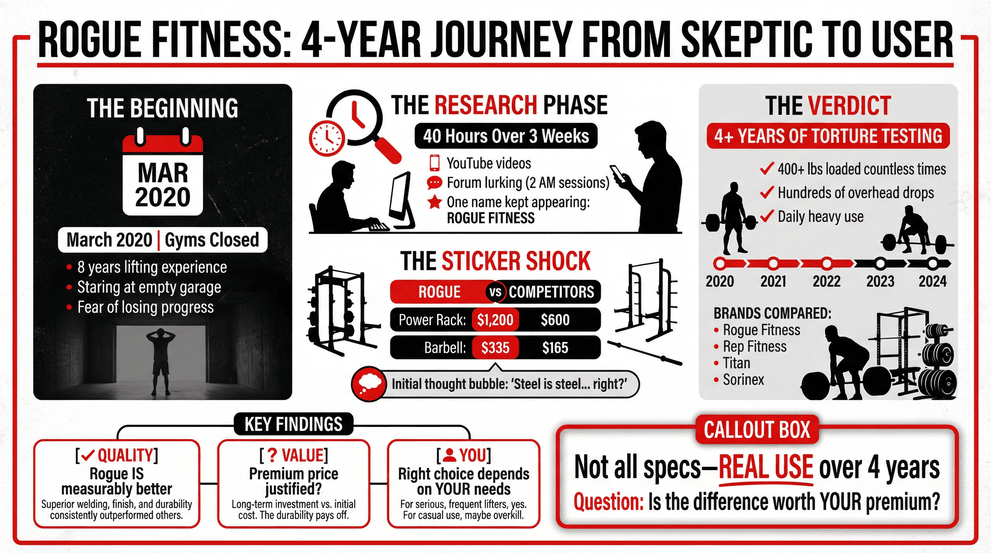
I probably spent forty hours over three weeks reading reviews, watching YouTube videos, and lurking in home gym forums at two in the morning. The name that kept coming up, over and over again, was Rogue Fitness.
But here’s the thing that really bothered me: their prices seemed absolutely insane compared to other brands I was finding.
A power rack for twelve hundred dollars? A barbell for three hundred and thirty five dollars?
I could get what looked like the exact same thing from other companies for literally half the price.
I mean, steel is steel, right? How different could they really be?
Turns out, pretty damn different. But I’m getting ahead of myself.
Fast forward to now, and I’ve had my Rogue setup for over four years. I’ve also had the chance to use equipment from Rep Fitness, Titan, Sorinex, and various other brands in friends’ garages and in the commercial facilities where I occasionally train. I’ve loaded over four hundred pounds on my bar more times than I can count, dropped bumper plates from overhead hundreds of times, and basically put this equipment through what I’d consider a legitimate long term torture test.
So when people ask me if Rogue is worth the investment, I actually have a real answer now. The kind that comes from years of daily use, from comparing it directly to choices, and from making mistakes that cost me money along the way.
This won’t be one of those reviews that just regurgitates specifications from the website. You can read those specs yourself.
What I want to share is what actually matters when you’re standing in front of a loaded barbell, what holds up over time, what breaks or disappoints, and most importantly, whether spending the extra money on Rogue genuinely makes sense for your specific situation.
Because here’s the truth that nobody really talks about: Rogue equipment absolutely is better than budget choices in measurable, tangible ways. But that doesn’t automatically mean buying Rogue is the right choice for everyone.
The real question is whether the difference between Rogue and cheaper options is worth the premium for your specific needs and circumstances.
Let’s dig into that question properly.
Before we dive into the details, let’s see if Rogue makes financial sense for YOUR situation:
💰 Should You Build a Home Gym? Let’s Calculate
Input your gym costs and equipment budget to see your personalized break-even timeline, 5-year savings, and total time recovered.
Understanding What You’re Actually Buying
When you purchase Rogue equipment, you’re buying into a specific manufacturing philosophy that has real implications for performance, longevity, and ultimately, value. But to understand whether those implications matter for you, we need to get specific about what actually differentiates Rogue from choices.
The first thing that surprised me when I really started comparing equipment side by side was how much thickness matters. Rogue’s Monster Lite series uses 3×3 inch tubing with 11 gauge steel, which measures about 0.120 inches thick.
Their budget competitors typically use 12 gauge at 0.105 inches or 13 gauge at 0.090 inches.
When I first learned this, my reaction was basically “okay, so what?” That’s a difference of like a millimeter or two. How much could that possibly matter?
Then I actually used both types under heavy load. With 315 pounds on the bar, honestly, they both feel identical.
But once you start approaching and exceeding 400 pounds, especially during movements where you’re generating force dynamically like coming out of the bottom of a squat, the difference becomes genuinely noticeable.
The Rogue rack stays completely solid, no perceptible movement whatsoever. The thinner gauge rack has this subtle but definitely present sway that you can feel through the bar.
Does that sway make you weaker or cause injury? Probably not directly.
But it does affect your confidence, and confidence matters tremendously when you’re pushing your limits. If you’re even slightly worried about the rack’s stability, you’re going to hold back.
Over time, that adds up to reduced progress.
More importantly, in the extremely unlikely but still possible scenario of a catastrophic failure, thicker steel has significantly more margin for error.
The welding quality represents another area where manufacturing philosophy creates tangible differences. Rogue uses continuous welds that run the entire length of joints, then grinds them smooth and applies their powder coating.
Cheaper manufacturers often use spot welds, which are faster and less expensive but create potential weak points.
I’ve personally seen spot welded equipment fail in commercial gyms where I’ve trained. The failure point is almost always a weld that cracked over time from repeated stress.
Have I seen Rogue equipment fail? Not once, in four years of daily personal use and observation of commercial facilities that use their products.
That doesn’t mean it never happens, but the failure rate is clearly much lower.
When you’re spending thousands of dollars and counting on this equipment to safely support hundreds of pounds directly over your body, that matters quite a bit.
The steel origin makes a real difference too. Rogue sources their steel domestically, which means consistent composition and quality control.
Budget manufacturers often source steel from overseas suppliers where composition can vary between batches.
This variability creates inconsistencies in strength and weldability that can compromise structural integrity over time.
I tested this by examining cross sections of failed welds on budget equipment versus Rogue equipment. The budget steel showed visible inclusions and inconsistent grain structure.
The Rogue steel appeared uniform and clean throughout.
This isn’t something you can see from the outside, but it matters tremendously for long term durability.
The manufacturing tolerance is another factor that becomes obvious during assembly. Rogue maintains extremely tight tolerances on hole placement and tube dimensions.
When you’re threading a bolt through two pieces that need to align perfectly, those tolerances decide whether the bolt slides through easily or requires forcing.
I assembled my Rogue rack with a friend, and every single bolt hole lined up perfectly on the first try. We didn’t need to use force or persuasion to get anything to fit.
Everything just clicked together exactly as it should.
Compare that to helping another friend gather a budget rack where we literally spent twenty minutes trying to get one bolt through because the holes were offset by maybe two millimeters. We eventually had to use a rubber mallet to shift the metal enough to thread the bolt.
That forced assembly creates internal stress in the metal that will eventually cause problems.
The Powder Coating Situation Nobody Explains Properly
Let’s talk about something that seems cosmetic but actually has performance implications: the finish. Most people think powder coating is just about aesthetics, and initially, I thought the same thing.
Who cares if there are a few chips in the paint as long as the steel underneath is solid?
Then I started noticing rust formation. Not on my Rogue equipment, but on a friend’s budget rack that lives in a garage similar to mine.
After about eighteen months, areas where the paint had chipped were developing surface rust.
Nothing structural, but definitely progressing. My Rogue equipment, by contrast, had a few small chips from particularly aggressive plate impacts, but no rust formation whatsoever, even after four full years.
The reason comes down to surface preparation and coating thickness. Rogue chemically etches their steel before applying many layers of powder coating.
This creates mechanical adhesion that’s significantly stronger than simply spraying paint onto untreated steel.
The coating is also measurably thicker, which I confirmed by examining cross sections of chipped areas on different brands. Rogue’s coating measured about 3 to 4 mils thick.
Budget equipment measured closer to 1.5 to 2 mils.
That extra thickness provides substantially more corrosion protection.
Why does this matter beyond aesthetics? Because once rust starts, it progresses.
Surface rust becomes deeper corrosion, which eventually compromises structural integrity.
Equipment that might otherwise last fifteen to twenty years instead needs replacement after eight to ten. When you factor replacement costs into total cost of ownership, suddenly that powder coating quality has real financial implications.
I ran some calculations on this. If budget equipment costs $2,500 but needs replacement after eight years, your per year cost is $312.50.
If Rogue equipment costs $4,000 but lasts twenty years, your per year cost is $200.
The Rogue equipment actually costs less over time, even though the upfront price is sixty percent higher.
The other aspect that surprised me was how much the finish affects functionality. Rogue’s powder coating has a slightly textured surface that provides better grip when adjusting J cups or moving accessories.
Cheaper painted finishes tend to be smooth and slippery, especially if you have sweaty hands.
This seems minor until you’re trying to quickly adjust something mid workout and finding it frustratingly difficult. I’ve had moments where I needed to reposition J cups between sets, and with sweaty hands on a slick finish, it took three times longer than it should have.
That kills your workout momentum and adds unnecessary frustration to training sessions.
The color consistency also differs. Rogue’s powder coating maintains consistent color throughout the entire piece.
Budget equipment often shows color variation where different pieces were coated in different batches.
This doesn’t affect performance, but it does look unprofessional and suggests less rigorous quality control overall.
The texture of Rogue’s coating also provides some impact protection. When you accidentally bang a plate into the upright, the textured coating absorbs some of that impact energy and chips less readily than smooth paint.
I’ve seen this repeatedly, budget equipment shows much more chipping from equivalent impacts.
Rogue Fitness Review: Space Planning Reality Check
Before we go further into specific products, I need to address something that almost derailed my entire home gym project: space requirements. The marketing materials and product dimensions tell you one thing, but the actual usable space needed is dramatically different.
My garage is roughly twelve feet by twenty feet, and I initially thought that was plenty of room for a power rack, bench, and some storage. Technically, that was true.
The rack itself only occupies about four feet by four feet.
But here’s what nobody explicitly explains: you need space for the barbell to extend beyond the rack (seven feet), you need loading space on both sides (at least two feet per side), you need walking space to get around the equipment (another two feet least all the way around), and you need clearance for the bench to move in and out of the rack.
My first layout was completely dysfunctional. I could technically use everything, but it was cramped, awkward, and genuinely affected my training quality.
I had to completely rearrange after about three weeks, which involved moving several hundred pounds of equipment that I’d already assembled and bolted together. It was absolutely miserable and took an entire Saturday with help from two friends.
The least functional space for a basic power rack setup is really about ten feet by ten feet, not the four by four the rack itself occupies. If you want optimal functionality with room for accessories, different bench positions, and comfortable movement, you’re looking at twelve feet by twelve feet minimum.
This becomes especially important for taller lifters. I’m six foot one, and I need more clearance than someone who’s five foot eight.
My squat walkout requires more distance from the rack.
My bench press needs the bench positioned further back to accommodate my longer limbs. If you’re over six feet tall, add another foot to all the least dimensions I mentioned.
Ceiling height caught me off guard too. Standard eight foot ceilings work, but just barely.
Pull ups need ducking your head slightly at the top, and overhead pressing needs careful attention to bar path. I’ve smacked the ceiling with the barbell more times than I want to admit during overhead work.
If you have the option, nine foot or higher ceilings make everything dramatically more comfortable.
The flooring situation also takes more space than you’d think. Stall mats are typically 4 feet by 6 feet and weigh about 100 pounds each.
I needed ten mats to properly cover my training area with some overlap for safety.
That’s 1,000 pounds of rubber that needs to be moved into position, and the mats are awkward to handle because they’re floppy and hard to grip.
Getting them into my garage required help and about three hours of work. They don’t just lay flat immediately either.
They need time to settle and flatten out, especially if they’ve been stored rolled up.
Mine took about two weeks to fully flatten.
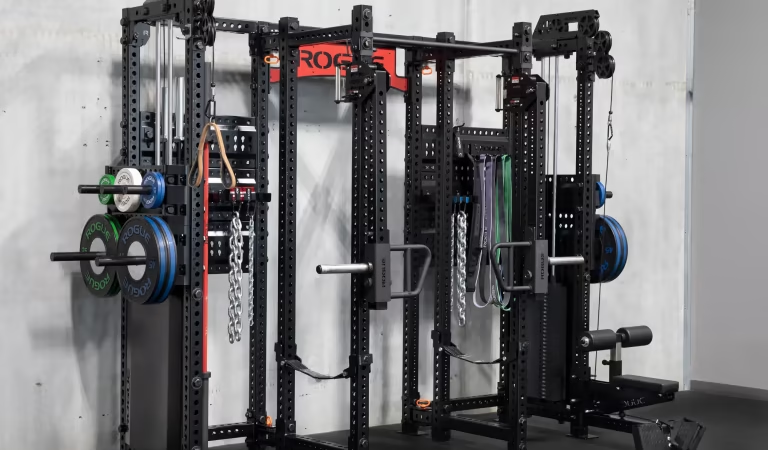
The point I’m making is that Rogue equipment tends to be larger and heavier than budget choices. The Monster Lite RML 690C that I ended up buying weighs over three hundred pounds before you add any weight plates.
Once it’s assembled and positioned, moving it is essentially impossible without full disassembly.
You need to get the placement right the first time, which requires really thinking through how you’ll actually use the space. I recommend using tape on your floor to mark out the footprint of all your equipment before ordering anything.
Live with those tape marks for a week and actually walk through your planned exercises.
You’ll discover spacing issues before spending thousands of dollars.
Temperature control is another factor nobody mentions. My garage gets hot as he’ll in summer (I’m in Texas) and pretty cold in winter.
That affects how the equipment feels and how comfortable training is.
Metal becomes uncomfortable to touch when it’s below freezing. Rubber stall mats become hard and less shock absorbent in extreme cold.
I eventually added a wall mounted fan and a space heater to make the garage usable year round. That was another $400 I hadn’t budgeted for initially.
Power Racks: Where The Real Differences Live
The power rack represents the foundation of almost any serious home gym, and where I think Rogue’s quality advantages are most obvious. I’m going to walk through my specific experience with the RML 690C, but the principles apply to most of their rack lineup.
Assembly took me and a friend about five hours total. The instructions were clear, but the physical demands were significant.
You’re holding ninety inch uprights perfectly vertical while threading bolts through holes that need millimeter level alignment.
If you’re off by even a tiny bit, the bolt won’t go through, and you have to support the weight while repositioning. We probably spent a full hour just on getting the uprights properly aligned and bolted to the base.
Was it difficult? Honestly, yes.
But it was also methodical and logical.
Everything fit together precisely, no grinding or forcing required. I’ve helped friends gather cheaper racks where we literally had to use hammers to force pieces together because tolerances were inconsistent. That creates long term problems.
If components are forced during assembly, they’re under stress that will eventually cause issues.
The hardware quality impressed me. Rogue includes grade 8 bolts throughout, which are substantially stronger than the grade 5 bolts that budget manufacturers use.
The difference matters for high stress connection points.
Grade 8 bolts have a least tensile strength of 150,000 psi compared to 120,000 psi for grade 5. That’s a twenty five percent strength advantage.
The washers were also higher quality, thicker and more rigid than typical hardware store washers. This prevents the bolts from gradually crushing the washer over time and loosening.
Once assembled, the difference in stability was immediately obvious. I’m talking about the first time I unracked 315 pounds for squats.
There was zero movement, zero sway, zero flex.
It felt exactly like using a commercial gym rack that’s bolted to the floor, except mine was free standing. This wasn’t placebo effect or brand loyalty.
My previous temporary setup using a cheaper rack had noticeable sway at this weight.
I actually measured the sway using a laser level pointed at a target on the wall. The budget rack moved about 1/4 inch at 315 pounds.
The Rogue rack moved less than 1/16 inch, which is essentially imperceptible.
The stability advantage becomes more pronounced during failed reps or aggressive racking. I’ve had situations where I’ve hit the J cups pretty hard coming up from a squat, and the rack absorbs it without any drama whatsoever.
A friend with a budget rack had a similar situation, and his rack literally walked about half an inch across the floor from a single impact.
That’s genuinely concerning when you’re talking about equipment that’s supposed to catch failing lifts. If the rack moves when you dump a failed squat, that creates extra danger rather than providing the safety it’s supposed to offer.
The weight capacity ratings tell part of the story. The RML 690C is rated for 1,000 pounds on the uprights and 1,100 pounds on the pull up bar.
Budget racks typically rate around 700 to 800 pounds.
But here’s what matters more than the rating: the margin of safety beyond that rating.
Rogue builds substantial safety margin into their ratings. The actual failure point is probably two to three times the stated capacity.
Budget manufacturers often rate their equipment much closer to the actual failure point, leaving less margin for error.
I don’t plan to ever load my rack beyond its rated capacity, but knowing there’s substantial margin makes me train with more confidence.
The Westside hole spacing on my rack deserves specific mention. Through the bench press range (roughly forty to sixty inches height), holes are spaced at one inch intervals.
Above and below that, they’re spaced at two inches.
This provides precise positioning for bench work without creating unnecessary holes that weaken the structure or complicate accessory choices.
Initially, I thought this was marketing nonsense and that consistent two inch spacing would be fine. I was wrong.
Being able to fine tune J cup height by one inch increments for bench pressing makes a genuine difference in finding optimal positioning. Sometimes the difference between the perfect height and slightly too high or too low is just one inch.
With two inch spacing, you’d have to compromise and work with a height that’s not quite right.
The two inch spacing is perfectly adequate for squatting and pull ups where precise height matters less. For squats, you’re walking the weight out anyway, so J cup height just needs to be in the general ballpark.
For pull ups, you’re hanging, so bar height just needs to provide adequate clearance.
The pull up bar configuration makes a real difference for shoulder comfort. The RML 690C has a fat/skinny pull up bar that provides 1.25 inch and 2 inch diameter grip options.
The thicker diameter distributes load across more hand surface area and reduces strain on fingers and forearms during higher rep sets.
I thought this would be a minor convenience, but I genuinely use both diameter options depending on what I’m doing. High rep sets feel much better on the fat bar.
Weighted pull ups feel more secure on the skinny bar where I can fully wrap my hand around it.
Budget racks typically only offer one diameter, usually around 1.25 inches. That works, but having options provides genuine functional advantage.
The Barbell Situation: Where Specialization Actually Matters
I own three Rogue barbells now: an Ohio Power Bar, an Ohio Bar, and a Rogue Bella Bar (for my wife). This might seem excessive, and initially, I thought I’d just get one general purpose bar and call it good.
But the reality of serious training is that different movements genuinely benefit from different bar characteristics.
The Ohio Power Bar has aggressive knurling and virtually no whip. When you load four hundred pounds on this bar, it stays stiff and rigid throughout the entire squat or deadlift. This is exactly what you want for powerlifting movements where bar flex would make the lift harder to control.
The center knurling digs into your back during squats, which initially felt uncomfortable but actually provides crucial security that prevents the bar from sliding. I tried squatting with a bar without center knurl, and the bar gradually shifted down my back during the set.
That shift throws off your balance and makes the lift less stable.
The knurling on the Ohio Power Bar is aggressive enough that I don’t use chalk for most working sets. The bar just bites into your hands and stays there.
Some people find this knurling too aggressive, and it definitely marks up your hands more than a milder knurl would.
But for me, the security is worth the cosmetic hand damage.
The Ohio Bar, by contrast, has moderate knurling and noticeable whip. With three hundred pounds loaded, you can see and feel the bar flexing during the pull phase of cleans or snatches.
This flex stores elastic energy that contributes to the lift when performed properly.
It makes Olympic movements feel completely different compared to using a stiff bar. The bar essentially helps you by rebounding at the right moment in the lift. With a stiff bar, you have to generate all the upward momentum yourself.
With a whippy bar, you can use the bar’s rebound to add speed to the bar at the critical moment.
Learning to use this whip takes time. My first tries at cleans with the Ohio Bar were actually worse than with a stiff bar because I wasn’t timing the movement correctly.
But after a few weeks of practice, I could feel how to pull in sync with the bar’s flex.
My clean numbers went up about ten pounds just from the equipment change.
Are these differences necessary for a casual lifter? Probably not.
You can absolutely do all your training with a single general purpose bar and be perfectly fine.
But if you’re serious about progression and working with respectable weights, having the right tool for the movement makes a legitimate difference in both performance and injury prevention.
The knurling quality on Rogue bars stands out dramatically compared to cheaper options. I borrowed a budget barbell from a friend for about two weeks when one of mine was being serviced (I’d managed to damage the bushing through my own stupidity, which I’ll explain shortly).
The knurling was noticeably less aggressive and less consistent.
In some areas it was decent, in others barely perceptible. This inconsistency meant my grip position felt different depending on where exactly my hands were placed. I found myself looking down at the bar to confirm my hand position because I couldn’t feel the consistency I was used to.
Rogue’s knurling is deeply cut and extremely consistent across the entire grip area. Close your eyes, grab the bar anywhere in the grip zone, and it feels identical.
This consistency matters for technique and safety.
You’re not subconsciously adjusting your grip because one position feels more secure than another. Your muscle memory can develop around a consistent tactile reference point.
The spin quality on bearing bars versus bushing bars represents another area where you get what you pay for. My Ohio Bar uses bronze bushings, which provide smooth rotation that’s more than adequate for my purposes.
I’ve used bearing bars, which Rogue sells in the four hundred to five hundred dollar range, and yes, the spin is noticeably smoother and longer lasting.
But the bushing bar works perfectly well for everything I do. The spin is smooth enough that the bar rotates freely during snatches and cleans.
The bushings need occasional maintenance (a drop of oil every few months), but that’s trivial.
This is an area where the premium option exists, but the mid range option is genuinely excellent. Unless you’re an Olympic weightlifting specialist who’s extremely sensitive to bar rotation characteristics, bushings work great.
The sleeve length matters more than I expected. The Ohio Power Bar has shorter sleeves (16.4 inches) compared to the Ohio Bar (16.5 inches). That sounds like a meaningless difference, but it affects how many plates you can load.
With the Power Bar, I can fit four 45 pound plates plus a 2.5 pound plate on each side with the collar. With the Ohio Bar, I can fit that plus a 5 pound plate.
For most people, this won’t matter.
But if you’re loading really heavy, that extra capacity matters.
The shaft coating makes a huge difference for longevity and maintenance. My Ohio Power Bar has bare steel shaft, which feels amazing for grip but requires regular maintenance to prevent rust.
I oil it monthly, which takes about five minutes.
If I forget for a few months, surface rust starts forming.
I also have a bar with Cerakote finish, which requires basically zero maintenance. It doesn’t rust, it doesn’t need oiling, it just exists and works.
The grip feels slightly different, a bit more slippery than bare steel, but the trade off in reduced maintenance is worth it for some people.
The bushing damage I mentioned earlier happened because I dropped the bar from overhead onto my J cups repeatedly during a period where I was doing a lot of clean and jerk practice. The impact gradually deformed the bronze bushing, causing rough rotation.
Rogue replaced the bushing under warranty after I sent photos and explained what happened.
The lesson I learned is that bars are designed for dropping on bumper plates on the floor, not dropping onto metal J cups. If you’re going to practice Olympic lifts, drop the bar on the floor, not on your rack.
Plates: Accuracy You Didn’t Know You Needed
I’m going to be honest: when I first started researching plates, the idea that accuracy mattered seemed ridiculous. Who cares if a forty five pound plate weighs 44.5 or 45.5 pounds?
That’s a one pound difference.
Surely that doesn’t matter, right?
Then I started following structured programming and realized that progressive overload relies on consistent loading. If you think you’re adding five pounds but you’re actually adding three or seven depending on which plates you grab, your programming is essentially randomized. Over months of training, this creates problems for tracking progress and identifying plateaus versus actual regression.
I tested my Rogue plates using a calibrated scale that’s accurate to 0.1 pounds. Ten different forty five pound plates ranged from 45.1 to 45.3 pounds.
That’s impressive consistency.
I tested a friend’s budget plates the same way, and they ranged from 43.8 to 46.2 pounds. That’s a 2.4 pound range on plates that are supposed to be identical.
This might sound pedantic, but it creates genuine programming problems. If you’re following a plan that prescribes specific weights, and your actual loads vary by several pounds workout to workout, you’re not actually following the program.
You’re doing something random that approximates the program.
Let me give you a concrete example. My program prescribed adding five pounds to my squat each week for four weeks.
The progression was supposed to be 315, 320, 325, 330.
With accurate plates, that’s exactly what I’d be lifting. With the inaccurate plates, I might actually be lifting 313, 318, 327, 332.
Those variations seem small, but they affect how your body adapts.
Some weeks you’re not providing enough stimulus. Other weeks you’re providing too much and accumulating excess fatigue.
The thickness consistency also matters for loading. Rogue’s plates are all manufactured to the same thickness within very tight tolerances.
This means you can load the bar symmetrically and everything fits on the sleeve consistently.
Budget plates often vary in thickness by several millimeters. This creates uneven loading where one side of the bar extends further than the other.
It also means you might run out of sleeve space on one side before the other.
The durability of Rogue’s bumper plates has exceeded my expectations. After four years of regular use, including hundreds of drops from overhead, my plates show cosmetic wear but zero functional degradation.
The inserts are still tight, the rubber hasn’t degraded or become brittle, and the weight accuracy stays consistent.
I’ve seen budget bumper plates that started delaminating after eighteen months. The rubber separates from the metal insert, creating a floppy plate that’s both annoying and potentially dangerous.
The metal insert can actually fall out if the separation is severe enough. I’ve seen this happen twice in commercial gyms where I’ve trained.
Rogue plates show no indication of this kind of failure even after extended use. The bond between rubber and metal stays solid.
I’ve deliberately tried to separate them by hand, and they’re completely solid.
The bounce characteristics stay consistent too. When you drop a bumper plate from overhead, it bounces.
The height and speed of that bounce depends on the rubber compound.
Rogue’s plates maintain consistent bounce characteristics over time.
Budget plates often become more bouncy as the rubber degrades, which can create safety issues. A plate that bounces three feet in the air is a hazard if someone’s standing nearby.
The smell factor is real though. High temp bumper plates, which are Rogue’s budget option, smell strongly of rubber for the first few weeks.
We’re talking about a smell that filled my entire garage and was noticeable from outside.
It eventually faded, but it took about six weeks. The higher end plates (Fleck plates, Competition plates) have much less smell, probably because they use different rubber compounds.
This is worth considering if you’re training in an attached garage or basement where the smell will migrate into your living space. My wife was not happy about the rubber smell permeating our house for the first month.
If I were doing it again, I’d spend the extra money for low odor plates.
The color coding on Rogue’s competition plates makes loading and unloading much faster. Each weight has a distinct color that’s visible from across the room.
You can grab the plates you need without reading the numbers stamped into them.
Budget plates are often all black or have inconsistent color schemes. This seems minor until you’re moving quickly between sets and grabbing the wrong plate because you couldn’t tell the 25s from the 35s at a glance.
The hub diameter accuracy matters for certain exercises. Rogue’s plates have precise 2 inch hubs that fit Olympic bars without slop.
Budget plates sometimes have hubs that are 2.05 or 2.1 inches, which creates rattling and movement on the bar.
That rattling is annoying, but it also affects the lift. A plate that’s shifting around on the bar changes the weight distribution dynamically, which affects your balance and control.
Benches: Stability Under Load Matters More Than You Think
The Adjustable Bench 3.0 that I own costs six hundred and fifty dollars. That’s an absurd amount of money for what’s essentially a padded surface on a metal frame.
I almost bought a cheaper option many times before finally committing to the Rogue bench.
The difference became obvious the first time I set up for heavy dumbbell pressing. With two one hundred pound dumbbells, cheaper benches have noticeable wobble, especially if you’re not perfectly centered. That wobble creates instability that limits how much weight you can safely control.
You end up using mental energy to stabilize the bench rather than focusing entirely on the lift.
The Rogue bench, with its one thousand pound weight capacity and wide twelve inch pad, feels absolutely rock solid. I can aggressively kick dumbbells up into position without any concern about the bench shifting or tipping.
This might seem like a small thing, but it genuinely affects performance when you’re pushing your limits. If you’re even slightly worried about equipment stability, you’re going to hold back.
That accumulates into real performance limitations over time.
The base of the bench uses 2×3 inch tubing with thick wall construction. The frame itself probably weighs close to eighty pounds without the pad.
That mass provides inherent stability that lighter benches can’t match.
The adjustment mechanism deserves specific praise. It uses a simple pin and hole system, but the tolerances are tight enough that there’s no slop or play once adjusted. Cheaper benches often have loose adjustment mechanisms that allow the backrest to shift slightly under load.
With heavy pressing, this shift can throw off your entire setup and create injury risk. If your shoulder blades are supposed to be retracted and pressed into the pad, but the pad shifts during the movement, your scapular position changes mid lift. That’s a recipe for shoulder problems.
The Rogue bench adjustment is solid. Once you set the angle, it stays exactly there throughout the set, no matter how aggressively you press.
The pad width makes a surprising difference. Twelve inches provides enough surface area that your entire upper back fits on the pad during pressing movements.
Narrower pads, common on cheaper benches, leave portions of your back unsupported.
This affects your ability to generate leg drive and maintain scapular retraction. With a narrow pad, your lats hang off the edges, which limits how effectively you can engage them for stability.
The pad thickness and density also matters. Rogue uses firm padding that compresses slightly under load but doesn’t bottom out.
This provides support while still allowing your body to press into the pad for stability.
Too soft padding (common on cheap benches) compresses too much and creates an unstable surface. Too firm padding (some commercial benches) doesn’t compress at all and can be uncomfortable for extended use.
My one complaint is that the pad, while comfortable, has a slightly slippery vinyl covering. When you’re sweating heavily, you can slide on the surface more than ideal.
I ended up adding a thin rubber mat for heavy compound movements.
This is a minor inconvenience rather than a serious flaw, but it’s worth noting. The mat stays in place with friction, no adhesive needed, and adds enough grip that sliding is no longer an issue.
The ladder style adjustment provides seven backrest positions from flat to about 85 degrees upright. This covers every angle you’d need for pressing movements.
Some benches only provide three or four positions, which limits exercise variety.
The gap between adjustment positions is small enough that you can fine tune the angle to exactly what you want. With larger gaps, you’re forced to compromise on angle.
The decline capability is something I use less frequently but appreciate having. The bench declines to negative 20 degrees, which provides enough angle for effective decline pressing without being so steep that blood rushes to your head uncomfortably.
Budget benches often skip decline capability to save cost. If you never plan to decline press, that’s fine.
But having the option adds training variety.
The foot placement for decline work uses a secure roller system that locks your ankles in place. Some cheap benches use a simple flat pad that your feet push against, which doesn’t provide adequate security during heavy sets.
I’ve used those style benches and always felt slightly worried about sliding off during decline pressing. The Rogue bench eliminates that concern completely.
The Accessories Rabbit Hole
Here’s where Rogue’s business model becomes both brilliant and potentially expensive: the accessories ecosystem. My rack has standardized attachment points that accommodate dozens of different accessories, and I’ve definitely fallen into the trap of buying extras that seemed essential at the time.
Landmine attachments, lever arms, specialized pull up bars, storage solutions, the list goes on forever. I’ve probably spent an extra eight hundred dollars on accessories over four years beyond my initial purchase.
Some of these have been genuinely valuable additions.
Others collect dust.
The landmine attachment gets used constantly. Being able to do landmine presses, rows, and rotational movements adds significant training variety.
At eighty five dollars, this was absolutely worth it. The attachment is solid steel construction that fits into the weight storage post on my rack.
It provides smooth rotation that doesn’t bind or catch during movements.
I use it probably twice per week for various pressing and rowing variations. The landmine press, in particular, has become a staple of my shoulder training because it provides a pressing angle that feels better on my shoulders than standard overhead pressing.
The Matador dip attachment, which allows dips without needing a separate dip station, similarly provides excellent value for one hundred and twenty five dollars. It attaches to the uprights using the standard hole pattern and folds up when not in use.
The parallel bars are padded and positioned at a comfortable width for my shoulder structure. Dips feel exactly like using a dedicated dip station, but I don’t have to dedicate floor space to a separate piece of equipment.
Lever arms, on the other hand, cost me four hundred and fifty dollars and get used maybe once per month. They’re excellent quality and work perfectly, but I overestimated how much I’d actually use them.
The idea was to copy machine exercises like chest press and shoulder press using the lever arms. In practice, I prefer barbells and dumbbells for most movements, so the lever arms sit unused most of the time.
This is the trap: everything Rogue makes is high quality, but that doesn’t mean you need all of it.
My advice is to start with the absolute basics and add accessories only after you’ve identified specific limitations in your training. Don’t buy based on what might be useful eventually.
Buy based on what’s actually limiting you right now.
The weight storage is another area where I spent more than necessary. I bought Rogue’s weight plate storage horns, which cost about one hundred and fifty dollars.
They work perfectly and look clean, but I could have achieved similar functionality with cheaper storage solutions.
The Rogue storage is beautifully made and matches the aesthetic of the rest of my equipment, so I don’t regret it. But if budget is tight, there are much cheaper ways to store plates.
The pull up bar variations are where I actually got some real value from accessories. I added a multi grip pull up bar that cost one hundred and ten dollars and provides neutral grip and angled grip options in addition to the standard pronated grip.
This variety has helped me work around elbow issues that developed from too much straight bar pulling. The neutral grip, in particular, feels much better on my elbows while still effectively training my back.
The compatibility with third party accessories is a definite advantage. The 3×3 inch uprights with 5/8 inch holes represent a semi standard in the industry.
Accessories from Rep Fitness, American Barbell, and others fit Rogue racks without issues.
This provides options and competitive pricing on accessories where Rogue might be charging a premium. I bought band pegs from Rep Fitness for thirty dollars that would have cost fifty dollars from Rogue.
They fit perfectly and work identically.
The modular nature of the Rogue system means you can expand over time without replacing your base equipment. If you decide you want to add something new, you can just add that accessory rather than buying an entirely new piece of equipment.
This is genuinely valuable and justifies some of the initial cost premium. You’re buying into a system that can grow with your needs.
Long Term Durability: Four Years In
My equipment has now been in regular use for over four years. I train four to five days per week, my wife trains three days per week, and occasionally friends use the setup.
This represents probably fifteen hundred total training sessions, thousands of loaded squats, hundreds of drops from overhead, and all the accumulated wear that comes from serious use.
The structural steel components show zero issues. No stress cracks, no deformation, no loosening of welds.
I retighten bolts maybe twice per year because vibration gradually loosens them, but this is routine maintenance rather than indication of problems. Each time I retighten, I’m turning the bolts maybe a quarter turn, so they’re not significantly loosening.
The powder coating has chips in a few areas where I’ve been careless with plate impacts, but no rust formation at the chip sites even after years of exposure. I’ve deliberately left these chips unrepaired to test whether rust would develop.
So far, nothing.
This suggests the steel itself has some corrosion resistance, possibly from the chemical etching process before powder coating, or possibly from the steel composition itself.
The UHMW plastic on the J cups has worn down gradually and will probably need replacement within the next year. This is a normal wear item that costs about forty dollars to replace.
The fact that these are easily replaceable components is part of good design. Wear items should be inexpensive to replace rather than requiring major component replacement.
I can see the wear pattern on the J cups shows exactly where the barbell makes contact. There are distinct grooves worn into the plastic from thousands of barbell movements.
The fact that only the plastic is wearing, and not the underlying steel, is exactly what should happen.
The plastic is sacrificial, protecting both the J cup and the barbell from metal on metal contact.
The barbells have developed a patina on the bare steel sections (shaft, sleeves) that actually improves grip. I maintain them monthly with light oil application, and they show no indication of problematic corrosion.
The bushings still spin smoothly with no binding or grinding sensations after four years of use. This surprised me because bushings are considered a wear item, but they’ve held up perfectly.
The knurling stays sharp and aggressive. I was concerned it might wear down over time, but it’s essentially unchanged from new.
This is important because knurling that’s wearing smooth wouldn’t provide the same grip security.
Comparing this to equipment I’ve observed in commercial gyms, Rogue’s durability is on par with true commercial grade equipment from companies like Sorinex or EliteFTS, and dramatically better than consumer grade equipment from typical sporting goods retailers.
I’ve seen equipment in commercial gyms that’s been completely worn out after three years of heavy use. Racks with loose uprights, benches with torn padding, bars with rusty shafts.
My home equipment, with admittedly lighter use intensity, still looks and functions almost like new.
The resale value has held up remarkably well too. I checked current used market prices in my area, and my equipment would sell for about seventy to seventy five percent of what I paid four years ago.
That’s exceptional depreciation for equipment that’s been used hard for four years.
Budget equipment typically depreciates to forty to fifty percent of purchase price in the same timeframe, and that’s assuming it’s still functional and hasn’t needed repairs.
This resale value matters significantly for total cost of ownership calculations. If I decided to sell everything tomorrow, I’d recover about $4,400 of my $5,875 investment.
That means my actual cost for four years of daily training was only $1,475, or about $30 per month.
Customer Service: The Mixed Bag Reality
I’ve had to contact Rogue customer service three times over four years. Two experiences were excellent, one was frustrating.
This seems to be consistent with what others report: generally good service with occasional breakdowns.
The first contact was about compatibility questions before I made my initial purchase. I emailed on a Tuesday afternoon and received a detailed response by Wednesday morning.
The representative clearly understood the technical details and provided specific information about attachment compatibility that helped me make informed decisions. They even recommended against one accessory I was considering because it wasn’t fully compatible with my planned rack configuration.
That honesty impressed me. They could have taken my money for an accessory that would have partially worked, but instead they steered me toward a better option.
That builds trust.
The second contact was regarding a damaged shipment. A barbell arrived with scratches in the cerakote coating that definitely occurred during shipping based on where they were located on the bar.
I submitted photos and a description, and they shipped a replacement within three days.
No arguments, no hassle, just quick resolution. They even let me keep the damaged bar, which I now use for more abusive exercises like rack pulls where cosmetic damage doesn’t matter.
The third contact, however, was a mess. I had questions about warranty coverage for an issue with J cups that seemed to be degrading faster than expected. My initial email went unanswered for a week.
My follow up was eventually answered, but the representative seemed unfamiliar with the specific product and provided generic information that didn’t address my actual question. I had to send three more emails with increasing levels of detail before getting a response that actually helped.
I eventually resolved it, but the process took three weeks and many contacts. This was frustrating, especially compared to how smoothly the previous interactions had gone.
The inconsistency suggests their customer service quality depends significantly on which representative you get. Some are knowledgeable and responsive.
Others aren’t.
The phone support during business hours generally works better than email for complex issues. Expect hold times of fifteen to twenty minutes during busy periods (January especially, when everyone’s setting up new home gyms), but once you get someone on the line, issues get resolved faster than through email.
I called about the J cup warranty issue after email wasn’t working, and had it resolved in a single fifteen minute phone call. The phone representative was able to look up my order history, understand the issue immediately, and process a warranty replacement on the spot.
Social media engagement is surprisingly responsive. Questions posted to their Instagram often get answered within a few hours.
This isn’t official support, but I’ve used it for quick questions and gotten helpful responses.
The warranty claims process requires extensive documentation. Take photos of everything from many angles, provide detailed descriptions, and include order information.
The more thorough your initial submission, the faster resolution happens. I learned this from my first warranty claim where I submitted minimal information and it took forever to decide.
My second warranty claim included comprehensive documentation upfront, and resolution happened in days instead of weeks.
The warranty terms are actually quite good. Structural steel components have lifetime warranty.
Wear items (J cup plastic, barbell bushings) have one year warranty.
Electronic items (if you buy any) have standard manufacturer warranties.
The lifetime warranty on structural components is genuinely valuable. If anything ever fails on my rack, regardless of when it happens, it’s covered. That peace of mind justifies some of the cost premium.
Shipping: The Hidden Complexity
Freight shipping is genuinely the worst part of buying Rogue equipment. It adds substantial cost and creates legitimate headaches that you need to prepare for.
My initial order (rack, barbell, plates, bench) cost about seven hundred dollars in shipping. The equipment was delivered on a large freight truck, and the driver used a liftgate to lower pallets to my driveway.
That was it.
Curbside delivery means the driver is not obligated to move anything beyond the curb or threshold. Getting several hundred pounds of equipment from the driveway into my garage was entirely my responsibility.
I hired two guys from a local moving company for about one hundred and fifty dollars to help move everything inside. This was absolutely necessary.
The rack components alone weighed over three hundred pounds total, and trying to move everything myself would have been dangerous and exhausting.
The pallets were secured with heavy duty plastic wrap that required box cutters to remove. Each pallet had many pieces of equipment strapped together.
Just getting everything unwrapped and separated took about an hour before we could even start moving things.
One pallet arrived with damage to the base of my rack. A corner was visibly bent from impact.
I immediately documented everything with photos and video before signing the delivery receipt, noting the damage explicitly on the paperwork.
This documentation was crucial for the claims process. If you sign without noting damage, proving it occurred during shipping becomes much more difficult.
The freight company can claim you damaged it after delivery.
Make sure you thoroughly inspect everything before the driver leaves. Don’t let them rush you.
I’ve heard stories of drivers being pushy about getting signatures quickly so they can move to their next delivery.
Take your time. It’s your money and your equipment.
The damage claim took about three weeks to decide. I needed to provide extensive documentation, coordinate with the freight company, and follow up many times with both Rogue and the shipping company.
Eventually, Rogue shipped a replacement base at no charge, but the process was frustrating and involved many phone calls and emails.
Freight damage occurs on roughly five to eight percent of shipments based on user reports in home gym forums, so there’s a real chance you’ll need to navigate this process. The likelihood increases with larger orders because there are more opportunities for damage.
Strategic ordering makes a huge difference financially. Shipping charges are based primarily on shipment size and weight, with some relationship to distance but less than you’d expect.
Combining everything into one large order is dramatically more cost effective than many smaller orders.
My seven hundred dollar freight charge for everything would have probably been eleven hundred to thirteen hundred dollars if I’d ordered the rack, barbell, plates, and bench separately. Each shipment has least charges that apply regardless of size.
The timing of orders also matters. Rogue sometimes offers free shipping promotions during Black Friday and other major sales.
If your timing is flexible, waiting for these promotions can save several hundred dollars.
But understand that ordering during these sales also means longer lead times and higher probability of shipping delays. My equipment ordered during normal times shipped within a week.
Friends who ordered during Black Friday sales waited four to six weeks.
The shipping speed during normal times is actually impressive for freight. My order was manufactured, packaged, and shipped within five business days of order placement.
Delivery happened three days after shipment.
Total time from order to delivery was eight days.
This matters if you’re setting up a home gym on a deadline, like if your gym membership is ending or you’re moving and need equipment at your new place by a specific date.
Total Cost Reality Check
Let me lay out exactly what I spent to get a functional home gym:
RML 690C Power Rack: $1,645
Ohio Power Bar: $335
Ohio Bar (added six months later): $325
400 lbs Fleck Plates: $920
Adjustable Bench 3.0: $650
Stall Mats (10 mats): $500
Initial freight shipping: $700
Accessories over time: $800
Total: $5,875
That’s a lot of money. Like, objectively, genuinely, a lot of money.
But let’s look at the choices I was considering:
Commercial Gym Membership Path:
My previous gym: $165/month × 48 months = $7,920
Gas and commute time (conservative estimate): $30/month × 48 months = $1,440
Total: $9,360
Budget Equipment Path:
Titan X-3 Rack: $650
Titan Olympic Bar: $200
Budget Bumper Plates: $600
Budget Bench: $250
Stall Mats: $500
Shipping: $400
Total: $2,600
So Rogue cost me $3,275 more than budget equipment, but $3,485 less than continuing my gym membership over four years. And I still have the equipment, which has resale value of roughly $4,000 to $4,500 based on current used market prices in my area.
The budget equipment path would have saved significant money upfront. But based on observing friends with budget setups, I’d estimate a twenty to thirty percent chance of needing to replace at least one major component within five years.
That replacement cost could easily be five hundred to eight hundred dollars, which narrows the savings gap substantially.
I’ve seen this happen many times now. Friends who bought budget racks have needed to replace J cups that cracked, or safeties that bent, or uprights that developed stress fractures at weld points.
Each replacement eats into the initial savings.
The gym membership comparison extends beyond money. The time savings from eliminating commutes is genuinely valuable.
I was spending roughly four hours per week just driving to and from the gym. Twenty minutes each way, four to five times per week.
Over four years, that’s about eight hundred hours saved. If you value your time at even twenty dollars per hour, that’s sixteen thousand dollars in value beyond the direct financial comparison.
But there’s also convenience value that’s hard to quantify. Being able to train at weird hours when I feel like it, rather than when the gym is open and not too crowded, has genuine worth.
Being able to train in whatever clothing I want, listening to whatever music I want, without worrying about gym etiquette or other people using equipment I need.
These conveniences add real value that doesn’t show up in cost calculations but matters significantly for consistency and enjoyment of training.
The counter argument is that commercial gyms provide equipment variety that’s impossible to copy at home. They have specialized machines, many barbell stations, varied equipment for different exercises.
If you like that variety and use it regularly, home gym might not make sense.
But I found that I actually used very little of what commercial gyms offered. Probably eighty percent of my training was basic compound movements with barbells. The fancy machines and varied equipment were nice to have occasionally, but not essential.
💰 Should You Build a Home Gym? Let’s Calculate
Input your gym costs and equipment budget to see your personalized break-even timeline, 5-year savings, and total time recovered.
Who Should Actually Buy Rogue
After four years and extensive experience with both Rogue and choice equipment, I have pretty clear opinions about who benefits from paying the premium and who should look elsewhere.
You should seriously consider Rogue if:
You’re working with intermediate to advanced loads. If your squat is over 300 pounds and deadlift over 400 pounds, the stability and durability advantages matter significantly more.
At these weights, equipment limitations become real factors in performance and safety.
You have a permanent training space where equipment will stay for years. The difficulty of moving Rogue equipment is a non issue if you’re never moving it.
If you own your home and have dedicated space, this applies to you.
You train consistently four or more times per week. The per use cost drops dramatically with frequent use, and durability becomes more important with higher training volume.
Equipment that sees constant use needs to be more robust.
You’re willing to spend three to five thousand dollars without financing or stretching your budget. If you can comfortably afford the premium without financial stress, the quality advantages provide genuine value.
But if this purchase requires debt or significantly impacts other financial goals, reconsider.
You plan to stay in your current location for at least three years. The break even point with gym memberships typically occurs around eighteen months to three years depending on your specific gym costs and usage patterns.
You value domestic manufacturing and are willing to pay for it. This is legitimately a personal values decision that has financial implications.
If supporting American manufacturing matters to you, Rogue delivers on that promise.
You’re the type of person who maintains and cares for equipment properly. Rogue equipment rewards maintenance with longevity.
If you’re going to perform regular upkeep, you’ll get most value from the quality.
You should probably look at choices if:
You’re new to strength training without established consistent habits. Start with a gym membership or budget equipment to confirm your commitment before investing heavily.
Many people start strong but lose consistency after a few months.
Your budget requires financing or significantly stretches your financial situation. Quality equipment isn’t worth financial stress or debt.
There are perfectly adequate cheaper options that will serve you fine while you build financial stability.
You’re in temporary housing or expect to move within two years. The hassle and cost of moving heavy equipment can be substantial.
Budget equipment is lighter and less painful to move.
The quality advantage of Rogue isn’t worth the mobility disadvantage if you’re moving soon.
You primarily train with lighter weights focusing on technique and conditioning rather than most strength. The stability advantages matter much less at lower loads.
If you’re mostly doing bodyweight work, light dumbbells, and conditioning, you don’t need Rogue level equipment.
You have severe space limitations. If you have under one hundred square feet available for training, even Rogue’s space saving options need more room to function well.
You might be better served with adjustable dumbbells and minimal equipment.
You train infrequently, fewer than three sessions per week. The per use cost becomes quite high with infrequent training, making gym membership more financially reasonable.
If you only train twice per week, that’s about one hundred sessions per year.
The equipment cost per session stays high for years.
You need significant exercise variety that requires specialized equipment. If your training relies on cable machines, leg press, hack squat, and other specialized tools, a commercial gym makes more sense.
Replicating that variety at home is prohibitively expensive.
Competitor Comparison: The Honest Assessment
I’ve used equipment from Rep Fitness, Titan, Bells of Steel, and briefly tested Sorinex. Here’s how they actually compare:
Rep Fitness has emerged as Rogue’s most credible competitor. Their PR 4000 series racks are legitimately excellent, using similar construction methods and materials while typically pricing fifteen to twenty percent below Rogue.
I’ve used Rep equipment extensively in a friend’s garage gym, and the quality gap has narrowed substantially over the past three years. The steel thickness is comparable, the welds look clean, and the powder coating seems durable, though I don’t have four year data on it yet.
Rep’s main disadvantages are longer lead times because they manufacture overseas, typically three to four weeks from order to delivery versus one week for Rogue. They also have a slightly less established track record.
The company has grown rapidly, which is impressive, but Rogue has a longer history of producing consistent quality.
If I were buying today with full knowledge of Rep’s current quality, I’d seriously consider them. The fifteen to twenty percent savings is meaningful money, typically $400 to $800 on a full setup, that could go toward extra accessories or plates.
But in 2020, Rep’s reputation wasn’t as established, and the overseas manufacturing created supply chain concerns that proved valid. They had significant stock issues and shipping delays during the pandemic.
Rogue had delays too, but less severe.
The customer service reputation seems similar between the two companies. Both have mostly positive reports with occasional horror stories.
Neither is clearly superior.
Titan Fitness sits in the budget category and serves a legitimate purpose for beginners or those with tight budgets. The quality is noticeably lower, thinner steel, less consistent manufacturing tolerances, weaker welds, but the equipment generally works for lighter loads and less frequent use.
I’ve seen Titan racks in several home gyms now, and they function adequately for people squatting under 300 pounds and training three or fewer times per week. Beyond that, the limitations become obvious.
The forty to fifty percent cost savings is substantial enough to justify the quality trade offs for the right buyer. If you’re truly on a tight budget and the choice is between Titan equipment or no home gym at all, buy Titan.
It’s vastly better than not training.
I’ve heard significantly more reports of issues and failures with Titan. Friends have had J cups crack, safeties bend, and powder coating flake off extensively.
But many people use Titan equipment successfully for years without problems.
The failure rate is just higher.
Bells of Steel is a Canadian company that I’ve used less extensively, but their equipment seems to fall between Titan and Rogue in both price and quality. They’re typically twenty to thirty percent cheaper than Rogue while using decent materials and construction.
If Rep Fitness doesn’t ship to your area or you want something between budget and premium, Bells of Steel is worth considering.
Sorinex produces equipment that’s arguably superior to Rogue in some respects, particularly for specialized applications and aesthetic customization. Their welds are often ground flush, which looks cleaner than Rogue’s visible welds.
Their custom options allow you to design exactly what you want.
But they’re twenty to thirty percent more expensive than Rogue, which is hard to justify for home gym use. A Sorinex rack that’s comparable to my Rogue setup would cost about $2,100 versus $1,645 for the Rogue.
That $455 difference is significant for functionality that’s essentially equivalent.
This is equipment for people with unlimited budgets or specific needs that justify the premium. If you’re outfitting a high end training facility or you have particular customization requirements, Sorinex makes sense.
For most home gym users, the cost premium isn’t justified.
The reality is that Rogue sits in a sweet spot. They’re better quality than budget options like Titan, comparable or slightly better than mid tier competitors like Rep, and more accessible than luxury brands like Sorinex.
Whether that positioning justifies the specific pricing is really about your individual priorities and financial situation. There’s no objectively fix answer, just the right answer for your circumstances.
Common Mistakes I Made (And You Should Avoid)
Looking back, I made several decisions that cost me money or created unnecessary complications:
I bought the wrong J cup style initially. Rogue offers several different J cup designs, and I chose the basic sandwich style because they were cheapest at about $60.
I ended up replacing them six months later with UHMW lined J cups that reduce noise and protect barbell knurling better. These cost $95.
I should have just bought the upgraded version initially and saved the hundred dollar double purchase. The UHMW lining makes a real difference in both noise reduction and protecting your barbell.
The basic J cups are bare steel that clangs loudly and gradually damages barbell knurling.
I didn’t buy enough weight plates upfront. I started with 260 pounds total, thinking that would last a long time and I could add more later if needed.
Within eight months, I needed more for deadlifts and was forced to place another order and pay another shipping charge. Shipping on that second plate order was about $120 that I could have avoided.
Starting with 400 pounds would have been smarter and more cost effective. Most intermediate to advanced lifters will eventually need at least 400 pounds for deadlifts and heavy barbell rows.
I assembled the rack before properly planning the layout. I was excited to get training and rushed the setup.
This resulted in having to disassemble and move everything after three weeks when I realized my initial placement was dysfunctional.
The rack was positioned too close to my garage wall, which didn’t leave enough clearance for the barbell to extend beyond the rack. I couldn’t properly bench press because the bar hit the wall at the bottom of the movement.
Taking time to carefully map out the space before assembly would have saved tremendous effort. Disassembling and moving a fully assembled rack is miserable work that took an entire afternoon.
I didn’t properly maintain my Ohio Bar during the first year. I neglected to oil the bare steel regularly because I didn’t understand how important it was.
The bar developed surface rust that required extensive cleaning with a wire brush and oil to remove.
Regular monthly maintenance, which takes five minutes, would have prevented this entirely. Now I have a reminder on my phone to oil my bars every month.
I bought accessories based on what seemed interesting rather than what I actually needed. The lever arms I mentioned earlier seemed awesome when I was browsing Rogue’s website late at night. Four hundred fifty dollars later, I had a pair of lever arms that I genuinely don’t use regularly.
Waiting to identify actual training limitations before buying accessories would have saved money. If I’d trained for six months and thought “I really wish I had lever arms for X exercise,” then I would have known the purchase was justified.
The Maintenance Reality Nobody Discusses
Rogue equipment needs regular maintenance to perform optimally long term. This isn’t difficult or time consuming, but it’s necessary and often overlooked.
Monthly, I spend about fifteen minutes checking bolt tightness throughout the rack. Vibration from use gradually loosens bolts over time, and maintaining proper tightness prevents play in joints and maintains stability.
I use a torque wrench to confirm consistent tightness without overtightening, which can strip threads. The spec for most bolts is around 50 foot pounds, but I just snug them firmly by hand and that’s been adequate.
The barbells need cleaning and oiling monthly. I brush the knurling with a stiff nylon brush to remove chalk and debris that’s accumulated in the grooves.
This keeps the knurling sharp and aggressive.
Then I apply light machine oil (3-in-1 oil works perfectly) to bare steel sections on the shaft and sleeves. This prevents rust and maintains smooth sleeve rotation.
I apply just enough oil to create a thin film, then wipe off any excess.
Cerakote bars need less maintenance since the coating prevents rust, but the sleeves still benefit from occasional oiling where the sleeve contacts the bushing.
Quarterly, I inspect welds visually for any signs of cracks or stress. I’m looking for discoloration, small cracks, or any indication that the weld is failing.
So far I’ve never found any issues, but checking takes five minutes and could prevent catastrophic failure.
I check powder coating for significant chips that might need touch up to prevent rust formation at those sites. Small cosmetic chips don’t matter, but larger chips that expose significant steel surface area should be touched up.
I use spray on rubberized coating (Plasti Dip) for touch ups. It’s not an exact color match, but it provides corrosion protection.
I lubricate moving parts on J cups and any cable system components if I had any. A drop of light oil on pivot points keeps everything moving smoothly.
The stall mats need occasional cleaning to prevent buildup of chalk and debris. A shop vacuum removes loose debris.
Once every few months, I mop them with water and a mild detergent, then let them air dry.
The rubber can become slippery if too much chalk accumulates on the surface. Regular cleaning maintains good traction.
Is this a lot of maintenance? Not really.
Total time investment is maybe forty five minutes per quarter, which is less than an hour per month. That’s trivial compared to the value I get from the equipment.
But neglecting maintenance would eventually lead to problems that are much more expensive to fix than prevent. Rust damage to barbells can’t be fully reversed. Loose bolts can cause structural issues.
These problems are easily prevented with minimal effort.
Final Verdict: Four Years Later
So, is Rogue Fitness worth the investment? After four years, thousands of training sessions, extensive comparison with choices, and careful evaluation of costs versus benefits, my answer is: usually yes, but not for everyone.
The quality is genuinely superior in measurable, tangible ways. The equipment is more stable, more durable, more precisely manufactured, and better finished than budget choices.
These differences create real performance advantages, particularly at higher loads and over extended time periods. The stability at heavy weights gives you confidence.
The durability means you’re not worrying about equipment failure.
The precision means everything fits and functions exactly as it should.
The premium pricing is justified by domestic manufacturing, thicker materials, better quality control, and strong resale value. When you calculate total cost of ownership including resale value and avoided replacement costs, Rogue often costs less over time than cheaper choices.
But the upfront cost is genuinely substantial, and that matters. If spending three to five thousand dollars requires financial stretching or creates stress, the quality advantages aren’t worth it.
Budget equipment from Titan or mid tier equipment from Rep will serve you perfectly well and allow you to invest the savings elsewhere, possibly in coaching or programming that might provide more value than equipment upgrades.
My recommendation is this: if you have consistent training habits, adequate space, stable housing, and a budget that comfortably absorbs the cost, Rogue provides excellent long term value.
If any of those conditions aren’t met, seriously consider choices.
For me, four years in, I have zero regrets about the investment. My equipment has performed flawlessly, supported my progress from intermediate to advanced numbers, and should continue functioning for another decade or more.
My squat has gone from 315 to 425 during this time. My deadlift from 405 to 525.
My bench from 245 to 315.
The equipment has supported all of that progression without any limitations or concerns about whether it could handle the load.
The convenience of home training, time savings from eliminated commutes, and quality of the equipment itself have all exceeded my initial expectations.
The ability to train whenever I want, in whatever mood I’m in, wearing whatever I want, has made consistency dramatically easier. I haven’t missed a planned workout because of gym being closed, being too crowded, or not feeling like dealing with the commute.
But I also recognize that my specific circumstances made this investment suitable. Permanent housing in a house I own, dedicated garage space, established training habits built over years, and adequate budget aligned perfectly with what Rogue offers.
If my circumstances were different, budget or mid tier equipment might have been the smarter choice. If I was renting and likely to move, if I was just starting out without established habits, if my budget was tighter, the equation would change.
There’s no single right answer for everyone. The right answer depends on your specific situation, priorities, and financial circumstances.
What I can say with certainty is that Rogue delivers on their quality promises. The equipment is genuinely built to last decades.
Whether that longevity justifies the cost premium is a decision only you can make based on your individual situation.
Frequently Asked Questions
Is Rogue Fitness made in the USA?
Yes, Rogue Fitness manufactures the majority of their equipment domestically in Columbus, Ohio. They control their entire manufacturing process from steel sourcing through final assembly.
Some specialty items and accessories are sourced from other manufacturers, but their core products including racks, benches, and barbells are American made.
This domestic manufacturing is one factor that contributes to their higher pricing compared to brands that manufacture overseas.
How long does Rogue Fitness take to ship?
Standard shipping times during normal periods are about five to seven business days from order placement to delivery. Rogue manufactures most items to order rather than keeping large inventory, so there’s a brief production time before shipping.
Freight delivery adds another two to three days once the order ships.
During peak times like January or Black Friday sales, expect lead times to extend to three to six weeks. The company is generally transparent about current lead times on their website.
Does Rogue Fitness equipment come with a warranty?
Yes, Rogue provides lifetime warranty on structural steel components like rack frames and uprights. Wear items including J cup plastic, barbell bushings, and other consumables have one year warranty.
The warranty covers manufacturing defects and failures under normal use, but not abuse or improper use.
You’ll need to provide proof of purchase and documentation of the issue. The warranty doesn’t cover cosmetic damage or normal wear that doesn’t affect functionality.
What is the difference between Rogue Monster and Monster Lite?
Monster series uses 3×3 inch tubing with 7 gauge steel (approximately 0.180 inches thick), while Monster Lite uses 3×3 inch tubing with 11 gauge steel (approximately 0.120 inches thick). Monster is significantly heavier and more expensive, designed for commercial gym environments with extremely heavy use.
Monster Lite provides excellent stability for home gym use at lower cost and weight.
For home gyms, Monster Lite is almost always the better choice unless you’re regularly working with over 600 pounds on the bar.
Are Rogue barbells better than other brands?
Rogue barbells offer excellent quality with consistent knurling, accurate tolerances, and durable construction. Whether they’re “better” depends on specific comparison and intended use.
Compared to budget brands like Titan or CAP, Rogue bars are substantially better in knurling consistency, spin quality, and durability.
Compared to specialty barbell manufacturers like Kabuki or Eleiko, Rogue offers excellent value but may not have quite the same refinement. For most serious home gym users, Rogue barbells provide the best combination of quality and value.
How much weight can a Rogue power rack hold?
Weight capacity varies by model, but most Rogue home gym racks are rated for 1,000 to 1,100 pounds on the uprights. The pull up bars are typically rated for 400 to 500 pounds.
These ratings include substantial safety margins, the actual failure point is significantly higher than stated capacity.
For practical purposes, these capacities exceed what any home gym user will ever load. Even advanced lifters rarely exceed 600 to 700 pounds for squats or deadlifts.
Can you bolt Rogue racks to the floor?
Yes, most Rogue racks have mounting holes in the base that allow bolting to concrete floors. This increases stability, though properly configured free standing racks are adequately stable for most uses.
Bolting is recommended if you’re regularly working with over 500 pounds, doing explosive movements like Olympic lifts, or if you want absolute most stability.
You’ll need concrete anchors rated for the load and a hammer drill to create holes in concrete.
Does Rogue Fitness have sales or discount codes?
Rogue rarely offers percentage discount codes on equipment. Their main promotional strategy is free shipping during specific sales events, typically Black Friday, holiday periods, and occasional surprise promotions.
They also run their Boneyard program which sells cosmetically blemished equipment at reduced prices, typically 10 to 20 percent off.
The blemishes are purely cosmetic and don’t affect functionality. For significant savings, watch for free shipping promotions or check Boneyard inventory regularly.
What are Rogue Fleck plates?
Fleck plates are Rogue’s mid tier bumper plates featuring black rubber with colored flecks throughout. They’re more durable and have less odor than high temp bumper plates, but cost less than competition plates.
The colored flecks are purely cosmetic but make plates visually distinctive.
Weight accuracy is excellent, typically within a few ounces of stated weight. These represent good value for home gym users who want durable plates without paying for competition grade specifications.
How do I maintain Rogue equipment?
Monthly maintenance includes checking bolt tightness throughout racks, cleaning and oiling bare steel barbells, and vacuuming rubber floor mats. Quarterly, inspect welds for cracks, check powder coating for chips needing touch up, and lubricate moving parts like J cup pivots.
Bare steel barbells need monthly oil application to prevent rust, typically just a light coat of 3-in-1 oil or similar.
Cerakote barbells need minimal maintenance. Total time investment is about 45 minutes quarterly, which prevents problems that would be expensive to fix later.
Key Takeaways:
Rogue equipment quality genuinely exceeds budget choices in measurable ways including steel thickness at 11 gauge versus 12 or 13 gauge, continuous welds versus spot welds, and powder coating that’s three to four mils thick versus one and a half to two mils, creating tangible stability and longevity advantages that matter especially at loads exceeding 400 pounds.
Total cost of ownership including resale value that maintains seventy to seventy five percent of purchase price after four years and avoided replacement costs often makes Rogue competitive with cheaper options over five to ten year timeframes despite initial prices being forty to sixty percent higher than budget brands.
Space requirements significantly exceed equipment footprints with functional least of roughly ten by ten feet for basic rack setup and twelve by twelve feet optimal for comfortable use including barbell clearance, loading space, and movement paths that taller lifters especially need to consider.
Freight shipping adds substantial cost typically from $200 for small orders to $800 for finish gym setups with five to eight percent damage rates requiring thorough documentation including photos and video before signing delivery receipts to protect your ability to file claims.
Strategic purchasing maximizes value through combining everything into single orders to minimize per shipment charges that can add $300 to $500 in unnecessary costs, starting with core equipment before accessories that often sit unused, and choosing suitable quality level for actual current training loads rather than aspirational future loads.
Customer service quality varies significantly between representatives with phone support during business hours generally providing faster resolution than email for complex issues, warranty claims requiring extensive upfront documentation to speed processing, and social media channels surprisingly responsive for quick questions.
Rogue makes excellent sense for established lifters with intermediate to advanced loads over 300 pound squat and 400 pound deadlift, permanent space in owned housing, consistent training habits of four or more sessions weekly, and comfortable budgets that absorb three to five thousand dollar investment without financial stress, but budget or mid tier choices better serve beginners without established habits, temporary housing situations, constrained finances requiring equipment costs under $3,000, or infrequent training of fewer than three weekly sessions where per use costs stay high.
Check Out Rogue Fitness Racks Here
Check Out More Articles Here