This article contains affiliate links to products we’ve researched and recommend. If you purchase through our links, we may earn a small commission at no extra cost to you. This helps us create free content like this guide. We only recommend equipment we believe provides genuine value. Read our full disclosure policy
I’ve watched too many people walk into a gym equipment store, see a power rack with “1,500 lb capacity” stamped on the specs sheet, and think they’ve got all the information they need. They hand over their credit card, feeling confident they’ve made a smart purchase.
Then six months later, they’re squatting 350 lbs and hearing their rack creak in ways that make their stomach drop.
The problem is that power rack weight capacity ratings are essentially the Wild West of gym equipment specifications. There’s no universal standard, no required testing protocol, and manufacturers can claim whatever numbers make their marketing team happy.
Some brands are conservative and build massive safety margins into their ratings.
Others push the absolute breaking point and call that the “capacity.”
You’re getting completely different products with identical capacity claims, and most buyers have no idea how to tell the difference.
Skip right to our Real Rack Capacity Calculator below
What Power Rack Weight Capacity Numbers Actually Mean
When you see a rack rated for 1,000 lbs, you need to immediately ask yourself what that number represents. Before diving into capacity specifics, understanding the broader landscape of home gym power rack options and features helps contextualize why capacity ratings matter so much
Static load capacity measures how much dead weight the rack can hold without moving.
If you loaded up 1,000 lbs of plates on the J-hooks and walked away for a week, the rack should theoretically support that load indefinitely without bending, cracking, or showing signs of stress.
But here’s where things get complicated. You’re not using your rack to store plates. You’re performing dynamic movements that create forces substantially higher than the loaded weight on your barbell.
Dynamic loading happens during the actual lift. When you descend into a heavy squat and reverse direction at the bottom, you’re creating acceleration forces that multiply the stress on your rack. That 400-lb barbell suddenly generates 500-600 lbs of peak force at the turnaround point.
Your muscles are fighting to control the descent, then explosively driving the weight back up.
Every movement creates force multiplication through basic physics.
The deceleration at the bottom of your squat, the explosive drive back to standing, and even the slight wobble when you’re grinding through a tough rep all create instantaneous stress peaks that exceed the static weight by 25-40%.
Most manufacturers rate their racks based on static capacity because it simplifies testing and makes the numbers look better. But that creates a dangerous gap between the listed specification and real-world performance.
A rack rated for 1,000 lbs static might only safely handle 700-750 lbs of working weight when dynamic forces are accounted for.
The diagram below shows why ‘advertised capacity’ and real-world stress are rarely the same thing.
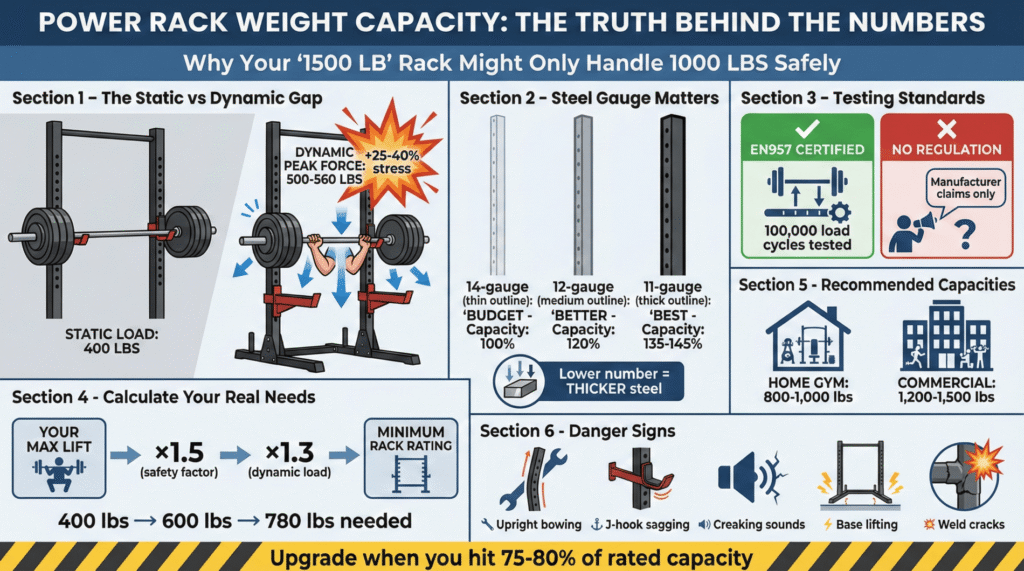
Use the tool below to see how your ‘static’ bar weight turns into much higher real-world stress during the rep.
Testing Standards That Actually Matter
European manufacturers that have obtained EN957 certification must put their racks through rigorous testing. The standard requires 100,000 load cycles at most rated capacity applied at the weakest structural point.
This cycle testing reveals problems that single-load testing completely misses.
A weld might hold 1,200 lbs perfectly during a one-time static test. But load and unload that same weld 50,000 times, and micro-fractures start forming in the heat-affected zone.
By cycle 75,000, those tiny cracks have propagated through significant portions of the weld.
One more heavy lift, and the whole thing lets go.
Cycle testing simulates years of actual use compressed into a controlled test environment. It catches manufacturing defects, design flaws, and material weaknesses that wouldn’t otherwise be apparent.
In North America, Australia, and most other markets outside Europe, there’s basically zero regulation. A manufacturer can stamp “2,000 lb capacity” on a rack welded together in a garage, and there’s no law against it until someone gets injured and lawyers get involved. The lack of mandatory testing creates a massive quality gap between reputable brands that voluntarily test their equipment and bottom-tier manufacturers that just make up impressive-sounding numbers.
Some manufacturers use use-based capacity ratings, rating equipment at loads that can be safely repeated thousands of times. The actual breaking point might be 2-3 times higher than the rated capacity.
This conservative approach builds in substantial safety margins, but it also means the capacity number doesn’t reflect the rack’s physical capacity.
Other brands rate right at the breaking point with minimal safety buffer. Both approaches produce racks labeled with identical capacity numbers that behave very differently in real conditions.
Steel Thickness Changes Everything
The steel gauge number on steel works backward from what most people expect.
Lower number = thicker steel
Higher number = thinner steel
An 11-gauge steel upright is substantially thicker than a 14-gauge one, and that thickness difference directly determines how much stress the frame can withstand before permanent deformation begins.
When a load is applied to a steel frame, the stress distributes across the material’s cross-sectional area. Thicker steel has more area to spread that stress, which reduces the concentration at any single point.
The relationship isn’t linear either.
Going from 14-gauge to 11-gauge doesn’t just give you slightly better performance. It can increase load capacity by 35-45% on the same design.
Budget racks use 14-gauge or thinner steel because it saves meaningful money on materials and makes the rack lighter for shipping. But that cost savings comes directly out of your safety margin. The frame simply cannot handle the same loads as a properly constructed rack with 11-gauge uprights and crossmembers.
For a detailed comparison of steel specifications across budget, mid-range, and premium racks, see our complete home gym power rack buying guide.
Weld quality matters even more than steel thickness in some ways, because a weld is the one spot where you’re joining two pieces of metal together. A perfect weld creates a bond stronger than the base material.
The heat-affected zone becomes a continuous structure without weak points.
Poor welding leaves gaps in the penetration, creates inconsistent bead patterns, and introduces stress risers where cracks can start. These defects might not be visible from the outside, but they fundamentally compromise the structural integrity.
A rack with excellent steel but terrible welds will fail at loads well below its theoretical capacity.
High-end manufacturers use robotic welding systems that deliver consistent, full-penetration welds on every joint. The robot follows the exact same path with the exact same heat and speed every single time.
Human welders, even skilled ones, introduce variability that can create weak spots.
When you’re examining welds in person or in detailed product photos, look for smooth, even beading without gaps or excessive buildup. Poor welds show irregularities, visible gaps between passes, or burn marks around the weld zone.
These visual indicators correlate with structural weaknesses that testing would reveal.
Calculating Your Real Capacity Needs
Start with your current most lifts across all exercises you’ll perform in the rack. If your best squat is 405 lbs and your best deadlift is 495 lbs, you need capacity for at least 540 lbs when you include the 45 lb Olympic barbell.
That’s the absolute floor with zero safety buffer.
I recommend buying a rack rated for 1.5 times your current working weight. Using that same example, 540 lbs times 1.5 equals 810 lbs, the least capacity.
Once you’ve calculated your capacity requirements, follow our 4-step process for choosing a home gym power rack to match the right construction quality to your budget and training needs.
This safety factor accounts for several critical variables that most people overlook.
First, you’re going to get stronger. If you’re training consistently and following decent programming, you’ll add 50-100 lbs to your squat over the next year or two.
The rack you buy today needs to serve you through several years of progression, not just handle your current numbers.
Second, dynamic loading effects add 20-30% to the actual stress your rack experiences. That 405 lb squat creates 485-525 lbs of peak force during the movement.
Your safety margin needs to account for these force multipliers, not just the plates on the bar.
Third, unexpected situations happen. You might miss a lift and dump the bar onto the safety pins from a height.
You might load the bar unevenly by accident.
You might have a training partner who’s heavier than you using the same equipment. All these scenarios create loading conditions that exceed your normal working weights.
For most serious home lifters, these calculations point to racks rated between 800 and 1,000 lbs. That range provides adequate headroom for progression, handles dynamic loading safely, and builds in a buffer for unexpected situations.
Commercial gym environments or competitive powerlifters need capacity in the 1,200-1,500 lb range to accommodate heavier lifters and more intensive use patterns.
Weight capacity ratings don’t exist in a vacuum—if you’re training in a basement or garage, ceiling height can significantly limit which racks actually work in practice, which is why this low-ceiling power rack guide walks through the best options for tight spaces.
Real Rack Capacity Calculator
Use the calculator below to translate everything you’ve just learned into a realistic rack rating for your lifts.
Real Rack Capacity Calculator
Enter your max lifts and your rack’s advertised rating to see a realistic recommendation (dynamic loading + safety margin).
1) Enter your numbers
2) Training style
3) Rack steel gauge
4) Certification
Important: This tool estimates peak (dynamic) stress and adds a safety factor for progression + “what-if” scenarios. Use it as guidance, not certification.
Your results
Advertised vs Required
💡 Tip: If you’re close to the line, prioritize thicker steel (11–12 gauge), quality hardware, and real testing over a flashy marketing number.
How Different Exercises Stress Your Rack
Squats create primarily vertical loading through the center of the frame. The weight sits on your back, you descend under control, and you drive back up through the same path.
The stress concentrates at the J-hook attachment points and travels down through the uprights into the base.
Squat depth affects the stress distribution more than most people realize. A high squat keeps most of the load near the top of the rack where the J-hooks attach.
A deep squat extends the force path down the entire upright length, which actually distributes stress more evenly and tests the frame’s full structural integrity.
Your safety pin positioning matters tremendously for squats. The pins need to sit at your lowest controllable depth so they catch a failed rep without forcing you to deliberately drop onto them during normal sets.
Pins set too high create a dangerous situation where you’re tempted to go lighter than necessary.
Pins set too low don’t provide adequate protection during actual failure.
Bench pressing inside a rack creates different mechanical demands. The J-hooks need to hold the barbell with essentially zero deflection because any sagging changes your bar path and makes the lift feel wrong.
You’re also loading and unloading the bar from the hooks many times per set, which creates repetitive stress on the attachment points.
J-hook quality becomes the limiting factor for heavy benching. Commercial racks use sandwich-style J-hooks with UHMW plastic inserts rated for 700-900 lbs, providing superior strength and minimal deflection.
Budget J-hooks stamped from thin steel will sag under heavy loads and wear out their attachment points over time.
Pull-ups and muscle-ups create stress patterns that surprised me when I started researching the actual forces involved. A 200-lb person performing strict pull-ups exerts roughly 200 lbs of downward force on the pull-up bar. But explosive muscle-ups or kipping pull-ups can generate 350-450 lbs of instantaneous stress due to momentum changes at the top.
The pull-up bar attachment method decides whether the rack can safely handle these dynamic loads. Bars that bolt directly through the uprights are substantially stronger than bars that slip into mounting brackets.
Through-bolted pull-up bars can typically handle 400-500 lbs safely.
Bracket-mounted bars might be limited to 250-300 lbs, depending on the bracket design.
Weight ratings are only meaningful when paired with proper rack design, which is why selecting the right power rack for a garage gym requires understanding footprint, stability, and real-world use — not just advertised numbers.
Warning Signs Your Rack Is Overloaded
Frame deflection is the most obvious warning sign that you’re exceeding safe capacity. If your uprights visibly bend when you load the bar onto the J-hooks, the steel is being stressed beyond its elastic limit.
You’re creating permanent deformation that weakens the structure even after you remove the load.
Minor deflection might only be visible if you’re looking for it. The uprights might bow slightly inward under heavy loading.
The base might lift slightly on one side during a hard set.
These subtle movements show the rack is being pushed to its limits and might not have an adequate safety margin for continued use.
J-hook sagging indicates that the hooks or their attachment points aren’t adequately rated for your working weights. Quality J-hooks should show zero visible deflection under any load you’re capable of lifting.
If the bar sits noticeably lower when loaded compared to empty, you need stronger J-hooks or a different rack entirely.
Creaking or popping sounds during lifts show movement somewhere in the structure. Brand-new racks might make some noise as everything settles and breaks in over the first few weeks.
But persistent noises that continue or worsen over time suggest bolts are loosening, welds are shifting, or structural components are moving under load.
Any visible cracking around welds means immediate retirement of the equipment. Cracks in welds show the joint has already partially failed and is in the process of complete failure.
You might get one more set, or ten more sets, or the next rep might be the one where it lets go entirely.
There’s no way to forecast when a cracked weld will fail catastrophically.
Weight capacity ratings affect not just the rack frame but also the safety bars, J-hooks, and other protective components, making choosing the right safety systems critical for reliable protection.
Use the checklist below to evaluate whether your rack is still operating within safe limits.
🏋️ Rack Failure Early Warning Checklist
Check any signs you’ve noticed under load. These are early indicators of structural fatigue or overload.
What Happens During Rack Failure
Gradual capacity loss is the most common failure mode for overtaxed racks. The frame doesn’t suddenly collapse in a dramatic failure.
Instead, the uprights slowly bend over the course of weeks or months of use.
The J-hooks gradually sag lower. Bolt holes elongate as fasteners work back and forth under load.
Each lifting session adds a tiny amount of permanent deformation. Eventually, the accumulated damage reaches a critical threshold at which the rack can no longer safely support loads it handled easily when new.
This gradual degradation is dangerous because it happens slowly enough that you might not notice the changes until you’re well past safe operating limits.
Catastrophic failures happen without warning when a structural component reaches its ultimate breaking point. Welds under excessive stress can hold for many repetitions before suddenly failing completely.
The weld that held 1,100 lbs successfully 50 times might fail on the 51st rep without any indication it was about to let go.
Bolt failures create particularly dangerous scenarios because the entire structure can shift or tip when fasteners fail. If the bolts connecting the uprights to the base give way, the rack becomes unstable, even though the barbell might still be resting on the J-hooks.
You’re suddenly off-balance with hundreds of pounds on your back and nowhere safe to put it.
The warranty implications of exceeding rated capacity are significant. Every manufacturer explicitly states that operating equipment beyond its specifications immediately voids all warranties.
That cracked upright from an overload situation won’t be covered for replacement.
The bent J-hooks from excessive weight are your problem, not the manufacturer’s.
More seriously, if someone gets injured using your overloaded rack, you potentially face personal liability because you deliberately used equipment beyond its rated capacity. The manufacturer’s warnings and specifications establish a clear standard of care that you violated by overloading.
When You Need To Upgrade
Your working weights consistently hitting 75-80% of rack capacity means you need to start shopping for an upgrade. At that threshold, you’re operating without an adequate safety margin for dynamic loads, strength progression, or unexpected situations.
If you’re regularly squatting 650 lbs in a rack rated for 800 lbs, you’re one bad rep away from structural problems.
Regular progression that adds 10-15 lbs per month to your lifts means you’ll exceed capacity within 6 months to 1 year. Don’t wait until you actually hit the limit.
Plan the upgrade when you can see you’re going to exceed safe capacity in the near future.
Physical signs such as frame deflection, J-hook sagging, or persistent structural noise indicate the rack has already been compromised beyond its original specifications. Even if a catastrophic failure hasn’t occurred, the accumulated damage has reduced effective capacity below the original rating.
A rack showing these symptoms needs replacement regardless of what the specification sheet claims.
Equipment age matters more than most people realize. A rack that’s 10-15 years old has accumulated thousands of load cycles, leading to material fatigue and cumulative stress damage.
The effective capacity of aged equipment is typically 10-20% lower than when new, even if there’s no visible damage.
When selecting a replacement rack, choose one rated for 1.5-2 times your current most working weight, not just a modest upgrade over your old rack. If you’re squatting 450 lbs now, look for racks rated for 700-900 lbs minimum.
This provides genuine headroom for continued progression and eliminates the constant worry about whether you’re pushing limits.
Verify construction materials before purchasing. Racks for serious lifting should use 11-gauge steel at least for uprights and major structural components.
Confirm weld quality through detailed product photos or, if possible, an in-person inspection.
Check for third-party testing certification or at least detailed information about the manufacturer’s testing procedures.
People Also Asked
What weight capacity do I need for a power rack?
Most home lifters need a rack rated for 800-1,000 lbs to safely accommodate current working weights plus room for progression. Take your most lift, add 50%, then add another 25% for dynamic loading.
Commercial gyms or advanced powerlifters need a 1,200-1,500 lb capacity.
Are power rack weight capacities accurate?
Capacity accuracy varies dramatically by manufacturer since there’s no required testing standard in most markets. European EN957 certified racks undergo legitimate 100,000-cycle testing.
Many budget brands make up numbers with zero verification testing.
What is the difference between static and dynamic load capacity?
Static capacity measures the amount of unmoving weight the rack can hold. Dynamic capacity accounts for forces during actual lifting that exceed the barbell weight by 25-40% because of acceleration and momentum changes during the movement.
How thick should the power rack steel be?
Quality racks use 11-gauge or 12-gauge steel for uprights and major structural components. Budget racks use 14-gauge or thinner steel, which reduces capacity by 35-45% compared to identical designs with thicker steel.
Can you exceed the weight capacity on a power rack?
Exceeding rated capacity can create dangerous situations in which structural components might fail without warning. It also immediately voids all manufacturer warranties and creates potential personal liability if anyone gets injured.
What safety features should I look for in a power rack?
Look for through-bolted pull-up bars, sandwich-style J-hooks rated for heavy loads, safety pins with UHMW plastic inserts, and overall construction using 11-gauge steel with quality robotic welds throughout the frame.
Do J-hooks have separate weight ratings?
Yes, J-hooks typically have lower capacity ratings than the overall rack frame. Commercial sandwich J-hooks are rated for 700-900 lbs, while budget stamped J-hooks might only safely handle 400-500 lbs.
Key Takeaways
Weight capacity ratings vary wildly between manufacturers because there’s no required testing standard in most markets, making it critical to research the brand’s actual testing procedures rather than just comparing numbers.
Weight capacity is a critical safety factor, but it’s just one element of choosing the right equipment. For comprehensive guidance on rack types, features, and selection criteria, read our complete guide to home gym racks.
Dynamic forces during lifting create 25-40% more stress than the static weight on the barbell, which means your rack needs to be rated substantially higher than your heaviest lift weight.
Steel gauge thickness and weld quality determine real-world capacity more than any marketing claims about commercial-grade or heavy-duty construction.
For home gyms, racks rated between 800-1,000 lbs provide adequate safety margins for most lifters, while commercial settings need 1,200-1,500 lb capacity for heavier users and more intensive training.
European EN957 certification requires 100,000 load cycles at maximum capacity, revealing fatigue failures that single static tests miss, making certified racks more reliably rated.
Exceeding rated capacity creates cumulative structural damage that leads to sudden failure without warning, voids all warranties, and creates serious liability concerns if injuries occur.