
This article contains affiliate links to products we’ve researched and recommend. If you purchase through our links, we may earn a small commission at no extra cost to you. This helps us create free content like this guide. We only recommend equipment we believe provides genuine value. Read our full disclosure policy
Titan T3 vs REP PR-4000 at a glance:
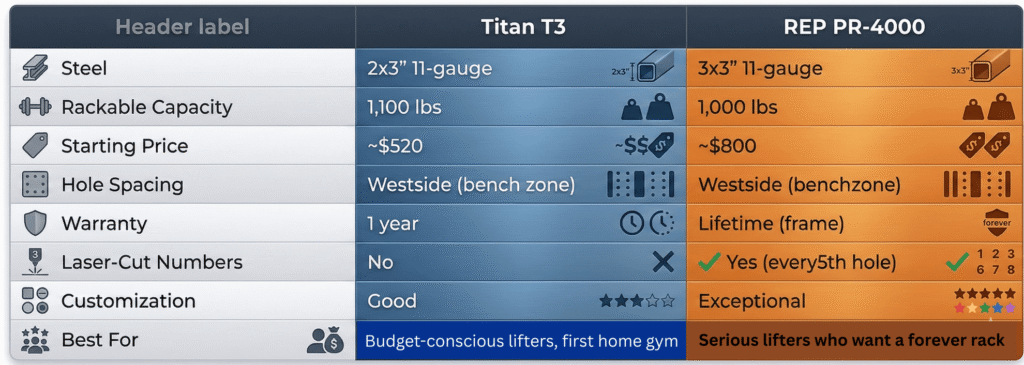
Bottom line: The Titan T3 is the smarter buy if budget is your primary constraint and you want a solid, proven rack without overthinking it. The REP PR-4000 is the rack you buy when you never want to buy a rack again. Both are excellent. Your bank account and your long-term training goals determine the winner.
The Titan T3 has over 300 reviews with a 4.9 Star average and the REP PR-4000 is highly praised by reputable sites like Garage Gym Reviews.
Introduction: The Rack That Almost Got Away
A few years back, a friend of mine spent three weeks agonizing over which power rack to buy for his garage gym. He had two finalists. He went back and forth so many times that his wife started referring to them by name, like they were characters in a drama. In the end, he made a choice, bolted it down, and has been lifting happily ever since. The rack he didn’t pick? He still wonders about it.
That story probably sounds familiar. Choosing a power rack feels consequential because it is. This is the centerpiece of your gym. Done right, you buy it once and train on it for a decade. Done wrong, you’re reselling it on Facebook Marketplace two years later and starting over.
The Titan T3 and the REP Fitness PR-4000 have become two of the most discussed racks in the home gym space, and for good reason. They sit close enough in price to create a genuine dilemma but far enough apart in philosophy to produce very different outcomes for different buyers. This comparison will help you figure out which one belongs in your garage, basement, or spare room.
Let’s cut through the noise.
PRICE:
- Titan T3 starts around US $520 and a full setup runs US $595–$650
- REP PR‑4000 base is US $800 and typical builds cost US $1 000–$1 100.
STEEL & CAPACITY
- T3 uses 2×3‑in 11‑gauge steel and supports 1 100 lb
- PR‑4000 uses sturdier 3×3‑in uprights.
WARRANTY & ATTACHMENTS
- T3 has a 1‑year warranty
- PR‑4000 has a lifetime frame warranty and modular attachments like the Ares functional trainer.
If you’re still in the early stages and want a full framework for evaluating any rack before committing, our power rack buying guide covers every spec category that actually matters for home gym lifters.
Not Sure Which Rack Is Right for You?
Take this quick 30-second rack matcher quiz to see whether the Titan T3 or REP PR-4000 fits your training style, budget, and long-term goals.
Which Rack Is Better For You?
Titan T3 vs REP PR-4000 — answer 6 quick questions to get your match
If you’re still early in the research process and want to understand the full landscape of rack options before narrowing your focus, our complete power rack buying guide walks through every major spec category and what actually matters for home gym lifters.
Understanding the Contenders
The Titan T3: The Rack That Built a Reputation
The Titan T3 has been around long enough to earn something that money can’t buy: a track record. Originally created as a budget alternative to the Rogue R-3, the early versions had legitimate quality issues.
Titan listened to the feedback (loudly, repeatedly delivered by the home gym community), addressed the problems, and the current T3 is a meaningfully improved product. Today, it’s one of the most-reviewed power racks in the garage gym world, with over 200 customer reviews on Titan’s own site, averaging 4.9 out of 5 stars.
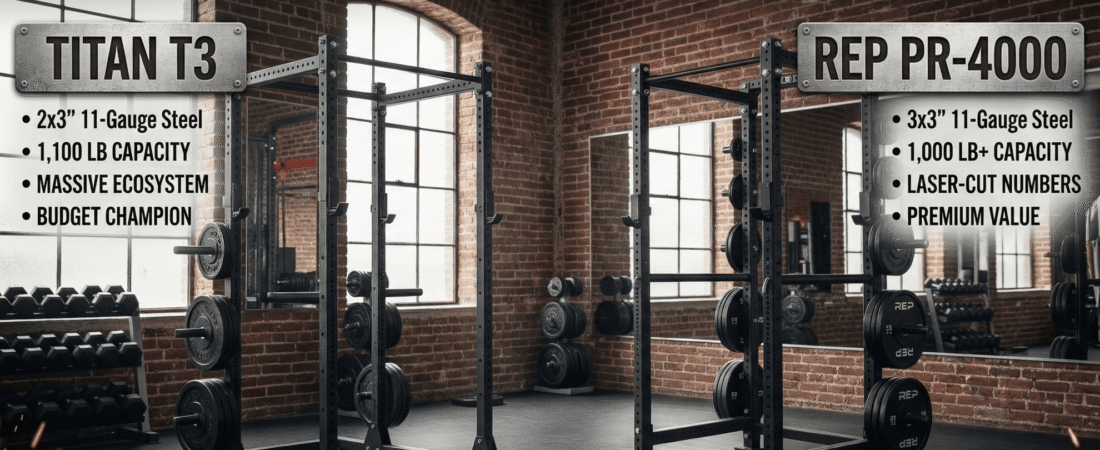
It’s built from 2×3″ 11-gauge steel with Westside hole spacing through the bench zone, comes in 82″ and 91″ height options, and offers 24″ or 36″ depth configurations. Starting around $520, it’s positioned as a serious rack for a budget-conscious price.
The REP Fitness PR-4000: The Modular Challenger
REP Fitness is a Colorado-based company that has spent the last several years quietly building one of the most respected product lineups in the home gym industry. The PR-4000 is their mid-tier rack, sitting between their entry-level options and the more premium PR-5000. But calling it “mid-tier” undersells it considerably.
The PR-4000 is built from 3×3″ 11-gauge steel (a meaningful upgrade over the T3’s 2×3), carries a lifetime warranty on the frame, features laser-cut numbers for easy attachment alignment, and offers a degree of customization that turns “buying a rack” into something closer to “configuring a system.”
It starts around $800 in base configuration, though most buyers end up spending more once they add safeties, pull-up bar options, and preferred attachments.
Steel, Construction, and Build Quality: Where the Gap Starts
This is the most important section of this comparison, so let’s spend some real time here.
Steel Size: 2×3 vs 3×3
The Titan T3 uses 2×3″ rectangular uprights, while the REP PR-4000 uses 3×3″ square uprights. Both are 11-gauge. Both are solid. But the 3×3 format has become the standard on premium racks for a reason: it’s stiffer, it handles lateral stress better, and it supports a broader attachment ecosystem because most high-end accessories are designed around the 3×3 standard.
For most home gym lifters, the 2×3 T3 is more than sufficient. A rack’s “feel” at 315 lbs is effectively the same whether you’re on 2×3 or 3×3 steel. But if you anticipate serious kipping movements, heavy eccentric loading, or eventually adding a cable attachment system, the 3×3 construction gives you more headroom.
Welds, Holes, and Finish
Both racks feature laser-cut holes and bolt-together construction. The T3 has improved significantly here since its early production runs. The welds are clean and consistent on current units. The PR-4000’s manufacturing process goes a step further with robotic welding and robotic painting all done under one roof, which translates into extremely consistent quality unit to unit.
One functional detail that matters more than it sounds: the PR-4000 has laser-cut numbers every fifth hole. The T3 has no numbers on the uprights at all. If you’ve ever tried to get your J-cups perfectly level on an unnumbered rack, you know exactly why this difference is worth noting. It’s a small thing until it isn’t.
Warranty: One Year vs. Lifetime
This comparison isn’t close. The Titan T3 carries a 1-year warranty. The REP PR-4000 comes with a lifetime warranty on the frame. That gap alone speaks to each company’s confidence in its product. For a piece of equipment you’re hoping to use for 10 or 20 years, warranty terms matter.
Comparing specs is one thing. Seeing current pricing is another. Both the Titan T3 and REP PR-4000 run promotions regularly. Before you make your final call, check live pricing on both:
[See Current Titan T3 Price →] | [See Current REP PR-4000 Price→]
Customization and Attachments: Different Philosophies Entirely
The Titan T3: Solid Ecosystem, Straightforward Options
The T3 supports a good range of Titan’s own attachments. You can add pin and pipe safeties, safety straps, a lat pulldown and low row, dip bars, plate storage, and various pull-up bar configurations. It’s a capable ecosystem for a wide range of training goals.
The limitation is that Titan’s attachment compatibility is primarily designed around its own product line. Cross-brand compatibility exists (particularly with other 5/8″ hardware racks), but requires careful research before purchasing any third-party accessory.
The REP PR-4000: A Modular System, Not Just a Rack
This is where the PR-4000 genuinely separates itself. REP built the PR-4000 as a platform first and a rack second. Their online Rack Builder lets you configure height (80″ or 93″), depth (24″, 30″, or 41″), color scheme, pull-up bar style, J-cup type, safety system, and add-ons before you ever place an order. You’re not buying a rack and hoping the accessories exist. You’re building the exact setup you want.
The attachment list is extensive: dip station, landmine attachment, band pegs, leg roller attachment, multiple cable pulley systems, and the flagship Ares functional trainer (a dual cable machine that bolts directly to the back of your rack). That last option is genuinely impressive.
Adding a cable system to a power rack used to mean buying a separate machine. With the Ares, it becomes part of the same unit.
For the lifter who eventually wants everything, the PR-4000’s ecosystem is the smarter long-term investment.
Real-World User Experiences
Case Study 1: The First Home Gym Build
Marcus, a recreational powerlifter in his mid-thirties, built his first real home gym during the pandemic gym closures and went with the Titan T3. His reasoning was straightforward: he had a $1,500 total budget for the rack, barbell, and plates. He couldn’t justify spending $800 on just the rack when $520 left him more to work with on everything else.
Two years later, he’s still training on it five days a week without issue. His one complaint: “Getting the J-cups level is annoying without any numbers to reference. I made a little mark with a paint pen after I found my spot. Problem solved.”
That is a very on-brand Titan T3 experience. A small frustration, easily worked around, and ultimately irrelevant to the quality of his training.
Case Study 2: The Upgrade Buyer
Jamie had trained on a budget 2×2 rack for three years before deciding she wanted something she’d never outgrow. She chose the PR-4000 with 41″ depth crossmembers, flip-down safeties, and a multi-grip pull-up bar. Her initial spend was around $1,400.
Six months later, she added the lat/low row attachment. A year after that, she’s eyeing the Ares cable system. Her take: “I never have to think about switching racks. I just keep building on what I have.”
That’s the PR-4000’s value proposition in one sentence.
Case Study 3: The Basement Gym with a Low Ceiling
Dave trains in a basement with just under 84 inches of ceiling clearance. He went with the Titan T3 in the 82″ configuration, which gave him just enough overhead room for pull-ups without the bar brushing the ceiling.
This is actually a genuinely useful data point: the T3’s 82″ option has a max pull-up bar height of 78″, which works in many basements where taller racks simply don’t fit. The PR-4000’s shorter option is 80″ uprights, which is comparably manageable.
If ceiling height is a constraint for you, check out our dedicated guide on this before buying.
Ceiling clearance is one of the most overlooked specs in home gym planning — our guide to the best power racks for low ceilings covers exactly what to measure and which configurations work best in tight overhead spaces.
Safety Systems: What Comes in the Box (and What Doesn’t)
Here’s a detail that catches some buyers off guard. Neither rack includes safety bars as standard. Both the T3 and the PR-4000 require you to purchase safeties separately.
Choosing the right safety system for your training style is worth its own deep dive — our power rack safety systems guide breaks down pin and pipe, strap safeties, and spotter arms with clear guidance on which suits solo training best.
For the T3, you’re choosing between pin and pipe safeties or safety straps. Both work well. The safety straps are generally preferred because they don’t damage your barbell if you drop weight onto them.
For the PR-4000, the options expand to include the highly regarded flip-down safeties, which offer a UHMW plastic lining and a cleaner setup experience for those who train solo.
If you train alone, safety systems aren’t optional. They’re essential. Budget for them upfront on whichever rack you choose.
For a deeper understanding of why safety systems matter and how to select the right one for your training style, the National Strength and Conditioning Association has published accessible guidance on home gym safety setup.
As strength coach Greg Nuckols of Stronger By Science has noted, the most expensive piece of gym equipment you’ll ever use is the one that injures you. Safeties are not a luxury.
Price: The Real Comparison
Let’s be honest about what you’re actually spending.
Titan T3 realistic cost to train:
- Base rack (82″, 24″ depth): ~$520
- Safety straps or pin pipes: ~$75
- Optional plate storage: ~$50
- Realistic total: $595–$650
REP PR-4000 realistic cost to train:
- Base rack (4-post, 80″, 24″ depth): ~$800
- Safeties (flip-down): ~$175
- Pull-up bar upgrade: ~$75
- Realistic total: $1,000–$1,100
The gap is real. For a first-home-gym build where the budget is shared across rack, barbell, plates, and bench, that $400–$450 difference is meaningful. For a lifter who’s already equipped and focused solely on the rack, the calculus shifts.
One thing worth factoring in: the REP PR-4000 comes with a lifetime frame warranty, while the T3 covers you for one year. If you plan to train on this rack for a decade, that warranty difference carries real financial weight (pun intended).
Many lifters compare Titan and REP to Rogue. Our Rogue Fitness Review explains how the premium brand compares.
The Honest Pros and Cons
Titan T3
Strengths:
- Outstanding value at the price point
- 1,100 lb rackable capacity (higher than PR-4000)
- Multiple height and depth configurations
- Westside hole spacing through bench zone
- Large and active user community
- Widely available attachment ecosystem
Limitations:
- 2×3 steel vs. 3×3 on the PR-4000
- No laser-cut numbers on uprights (J-cup alignment is manual)
- 1-year warranty only
- Recommended to bolt down for safety
- Fewer base color options than REP
REP PR-4000
Strengths:
- 3×3″ 11-gauge steel construction
- Lifetime warranty on frame
- Laser-cut hole numbers for easy alignment
- Exceptional customization via online Rack Builder
- Huge and growing attachment ecosystem (including the Ares cable system)
- Multiple height, depth, and color configurations
- Precision robotic manufacturing means highly consistent build quality
Limitations:
- Higher starting price (~$800 vs ~$520)
- Attachment costs add up quickly
- Base configuration requires purchasing safeties separately
- 4-post version benefits significantly from bolting down
Who Should Buy Which Rack?
Buy the Titan T3 if:
- You’re building your first home gym, and budget is shared across multiple equipment purchases
- You want a reliable, battle-tested rack without the modular complexity
- Your training is straightforward strength work with no plans to add cable systems later
- You’re comfortable with a one-year warranty and a bolt-down setup
- Your ceiling height demands the 82″ option specifically
Buy the REP PR-4000 if:
- You want one rack for the next 10 to 20 years, and you’re willing to invest accordingly
- Customization and future expandability matter to you
- You train solo and want the best safety system options available
- A lifetime frame warranty is worth the premium to you
- You’re drawn to the idea of eventually adding a cable machine to the same unit
The honest truth is that the Titan T3 is a better rack than its price suggests. And the REP PR-4000 is a better long-term investment than its price implies. Neither is a wrong choice. They’re answers to different questions.
Ready to make your decision? Use the links below to configure your preferred setup, check current stock, and compare bundle pricing. Both companies run limited-time promotions that can meaningfully shift the value equation. [Build Your REP PR-4000 →] | [Shop Titan T3 Configurations →]
Frequently Asked Questions
Is the Titan T3 worth buying in 2026?
Yes. The current T3 is a considerably improved rack from its early production versions. With laser-cut holes, improved welds, and a proven track record across thousands of home gyms, it remains one of the best budget power racks available.
The 1-year warranty and 2×3 steel are its main limitations relative to the PR-4000, but neither is a dealbreaker for most lifters.
What is the difference between 2×3 and 3×3 steel on a power rack?
The numbers refer to the cross-sectional dimensions of the upright tubing in inches. 2×3″ is rectangular; 3×3″ is square. Both the T3 and PR-4000 use 11-gauge steel, but the 3×3 format is stiffer and supports a broader range of cross-compatible attachments.
For most home gym lifters, 2×3 is sufficient. For those planning to load the rack heavily with accessories or training very aggressively, 3×3 provides additional rigidity.
Do I need to bolt down the Titan T3 or REP PR-4000?
Both manufacturers recommend bolting their racks down, particularly for the 4-post versions. The T3 explicitly recommends floor anchoring for safety.
The PR-4000’s 41″ depth configuration with rear base stabilizer can be used unbolted, but for most configurations bolting down is the safer and recommended approach.
Does the REP PR-4000 include safety bars?
No. The PR-4000 requires you to select and purchase safeties separately via the Rack Builder. Options include pin and pipe safeties, strap safeties, and flip-down safeties. Budget for this upfront.
Can I add a cable machine to the Titan T3 or REP PR-4000?
The REP PR-4000 has a purpose-built cable system (the Ares functional trainer) that mounts directly to the rack. It’s one of the PR-4000’s standout features.
The Titan T3 supports a lat pulldown and low row attachment, but it’s a simpler cable setup compared to the Ares.
Which has the better warranty?
The REP PR-4000 wins clearly here. It carries a lifetime warranty on the frame. The Titan T3 comes with a 1-year warranty on all products.
Is the REP PR-4000 compatible with Rogue or Titan attachments?
Partially. The PR-4000 uses 5/8″ hardware and 3×3 steel, which makes it compatible with some Rogue Monster Lite and Titan X-3 attachments.
However, REP uses metric hole spacing vs. the imperial spacing on USA-made racks like Rogue, which can cause fitment issues with dual-pin attachments.
Single-pin attachments tend to work fine. Always verify compatibility before purchasing third-party accessories.
What is Westside hole spacing?
Westside hole spacing refers to 1″ hole spacing through the bench zone of the uprights (vs. the standard 2″ spacing used above and below).
It allows for more precise J-cup and safety positioning during the bench press and clean pull zone, giving you finer height adjustments for a more comfortable and safer setup.
Both the T3 and PR-4000 feature Westside spacing through the bench zone.
Final Thoughts: Two Great Racks, One Clear Framework for Deciding
Here’s what I keep coming back to when I think about this comparison. Choosing between the Titan T3 and the REP PR-4000 isn’t really a question about which rack is objectively better. It’s a question about where you are in your training life and what you need your home gym to do for you.
If you’re building a first gym and every dollar matters, the Titan T3 is a smart, proven, honest choice. Buy it, bolt it down, train on it for years, and don’t look back.
If you’re building what you intend to be your forever gym, the REP PR-4000’s lifetime warranty, 3×3 construction, and expandable ecosystem make it the stronger long-term investment. The extra upfront cost buys you something real: a rack you’ll never need to replace and a platform that grows with you.
The best power rack is ultimately the one that gets you under the bar consistently. Both of these will do exactly that. Now the only question left is which one is going home with you.
Not Sure Which Rack Is Right for You?
Take this quick 30-second rack matcher quiz to see whether the Titan T3 or REP PR-4000 fits your training style, budget, and long-term goals.
Still weighing your options? Explore our full power rack comparison guide for even more options.
A Final Word
Buying a power rack is one of those purchases that pays compounding dividends over time. Every squat, every press, every pull-up done safely and consistently is an investment in something that matters far beyond the gym. Whether you land on the Titan T3 or the REP PR-4000, you’ve already done the hard part: you’ve taken your training seriously enough to build a real setup. What happens next is entirely up to you.