
This article contains affiliate links to products we’ve researched and recommend. If you purchase through our links, we may earn a small commission at no extra cost to you. This helps us create free content like this guide. We only recommend equipment we believe provides genuine value. Read our full disclosure policy
Quick Summary: Power Rack Buying Guide
Short on time? Here’s what you need to know about choosing a power rack for your garage gym:
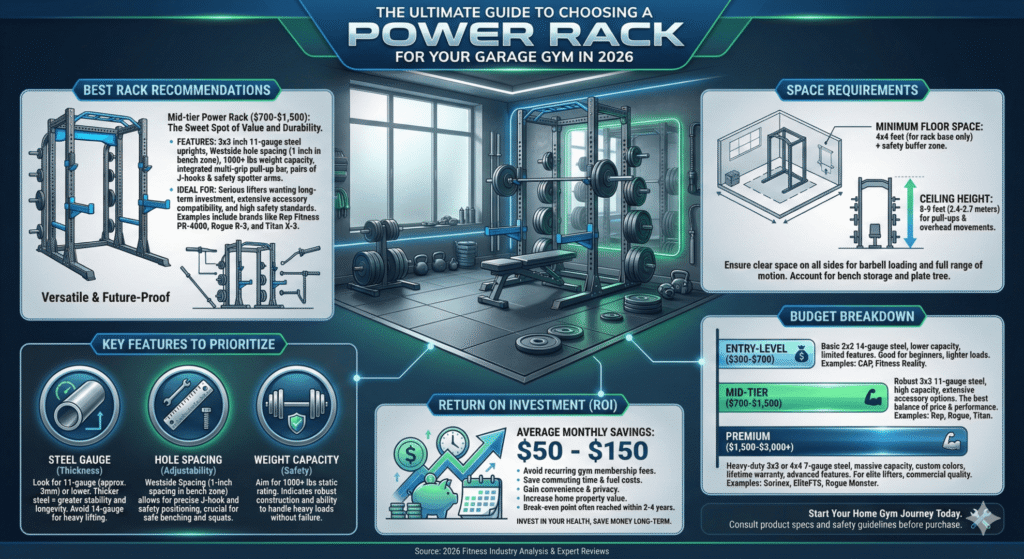
Best for most people: A mid-tier power rack ($700-$1,500) with 3×3-inch tubing, 1,000-pound capacity, and Westside hole spacing from brands like Rep Fitness, Rogue Fitness, or Titan Fitness.
Space requirements: Plan for 4×4 feet of floor space and 8-9 feet of ceiling height for standard racks. Tight on space? Wall-mounted foldable racks from Rogue Fitness or PRx Performance fold to just 4-6 inches when not in use.
Key features to prioritize:
- Steel gauge: 11-gauge or thicker for durability
- Hole spacing: Westside spacing (1-inch in bench zone) for precise adjustment
- Weight capacity: 1,000+ pounds for serious lifting
- Attachment compatibility: 3×3-inch posts with 5/8-inch holes offer most options
Budget breakdown:
- Entry-level: $300-$700 (adequate for beginners)
- Mid-tier: $700-$1,500 (best value for serious lifters)
- Premium: $1,500-$3,000+ (commercial quality)
Return on investment: According to data from Statista, average gym membership costs typically range from $50 to $100 per month, making a power rack for your garage gym setup a cost-effective long-term investment. paying for itself in 2-3 years.
Bottom line: Invest in the best rack your budget and space allow. A quality power rack lasts decades and becomes the foundation of effective home strength training.
Continue reading for detailed guidance on choosing the perfect rack for your specific situation
What Is a Power Rack and Why Do You Need One?
Setting up a power rack for your garage gym is one of the best investments you can make in your fitness journey. At the heart of any serious home strength training setup is a power rack—the single piece of equipment that transforms a basic workout space into a comprehensive training facility. But with hundreds of options available and prices ranging from $300 to over $3,000, choosing the right power rack for your garage can feel overwhelming.
This guide will walk you through everything you need to know to make a confident decision, from understanding which rack type works best for your space to determining which features matter most for your training goals.
A power rack (also called a power cage or squat cage) is a four-posted steel frame with adjustable safety bars that allows you to perform heavy compound lifts—squats, bench press, overhead press, and more—safely without a spotter. According to strength training experts at the National Strength and Conditioning Association, the safety bars catch the barbell if you fail a rep, making it possible to train to failure alone.
For garage gym owners, a power rack is the foundation of strength training because it consolidates multiple pieces of equipment into one footprint. Instead of needing separate stations for squats, bench press, pull-ups, and other exercises, a quality power rack handles them all.
If you’re still deciding whether a power rack is right for your setup or want to compare all rack styles side-by-side, our complete guide to the best home gym racks breaks down every option for different spaces and training goals.
Power Rack vs. Squat Stand vs. Half Rack: Which Is Right for Your Garage?
Before diving into specific models, you need to understand the fundamental differences between these three equipment types.
Power Rack (Full Cage)
A power rack features four vertical posts connected at the top, creating an enclosed cage. This is the gold standard for safety and versatility. The enclosed design provides maximum stability for heavy lifts and allows you to position safety bars inside the frame to catch failed lifts from any angle. Most power racks include pull-up bars and accessory attachment points for dip stations, landmines, and cable systems.
The tradeoff is footprint. Most power racks require approximately 4 feet of floor space by 4 feet of depth, with 8 to 9 feet of ceiling clearance. If you have the space and plan to lift heavy weights regularly, a full power rack is worth the investment.
Half Rack
A half rack uses the same four-post design but is only about half as deep, typically 2 to 3 feet deep rather than 4 feet. You walk out of the rack to perform squats rather than squatting inside the cage. This saves considerable floor space while maintaining stability for heavy loads.
The downside is reduced safety coverage. Since you’re lifting outside the rack, the safety bars only protect you if you can walk backward into position during a failed squat. For bench press, you’ll still have full safety coverage since you’re positioned inside the rack.
Half racks work well for experienced lifters comfortable with walkout squats and for those who need to maximize usable garage space.
Squat Stand
Squat stands (also called independent squat stands) consist of two separate vertical posts that aren’t connected. They’re the most compact option, with some models being completely portable or foldable against the wall.
The advantage is flexibility and a minimal footprint. You can move them around your garage, fold them away when not in use, or even take them outdoors. The disadvantage is stability—without connection points, squat stands can tip over if you rack the barbell incorrectly or bump into them. They also typically can’t handle as much weight or accommodate as many attachments as connected racks.
Squat stands are best suited for lighter training loads (under 400 pounds), those with extremely limited space, or as a secondary setup.
If you want a deeper comparison with real-world pros and cons, we break down each option in our complete home gym power rack guide.
🏋️ Power Rack Finder Quiz
Answer 7 quick questions to find your perfect garage gym power rack setup in 30 seconds
Key Features to Consider When Choosing a Power Rack for Your Garage Gym
Steel Gauge and Weight Capacity
Power racks are constructed from steel tubing, with thickness measured by gauge (lower numbers mean thicker steel). Most racks use 2×2-inch, 2×3-inch, or 3×3-inch tubing.
Steel gauge ratings can be confusing for first-time buyers, but understanding steel gauge thickness helps clarify why lower gauge numbers indicate stronger, more durable rack construction.
For serious strength training, look for 11-gauge or thicker steel (some commercial racks use 7-gauge). The weight capacity should exceed your maximum training loads by a comfortable margin. A rack rated for 700 to 1,000 pounds provides adequate headroom for most home lifters. If you’re a competitive powerlifter or plan to train with over 500 pounds regularly, consider racks rated for 1,200 pounds or more.
To understand how manufacturers calculate load ratings and what actually matters for safety, see our full power rack weight capacity guide.
Hole Spacing
The vertical posts of power racks are drilled with holes that allow you to adjust the height of J-hooks (barbell holders) and safety bars. Hole spacing determines how precisely you can set these heights.
Standard spacing is 2 inches throughout the rack. Better racks feature Westside hole spacing, with 1-inch spacing in the bench press zone (typically from 12 to 48 inches off the ground) and 2-inch spacing elsewhere. This allows precise positioning for bench press, which is critical for proper form and shoulder safety.
If you’re over 6 feet tall or under 5’4″, pay extra attention to hole spacing. You’ll need to adjust equipment heights more frequently to accommodate your proportions.
Depth and Footprint
Standard power racks are 24 inches deep inside the uprights, providing about 42 to 48 inches of total depth, including the back feet. This is adequate for squatting and bench pressing without feeling cramped.
Deeper racks (30 inches or more inside depth) provide more room for movements and accessories but require more garage space. Measure your available floor space carefully, accounting for barbell length when loaded on J-hooks (an Olympic barbell is 7 feet long, so each side extends about 3 feet from the rack).
Don’t forget to measure ceiling height. Most racks are 80 to 84 inches tall, but you’ll need several additional inches of clearance for pull-ups and to load plates onto a racked barbell overhead.
If your garage ceiling is under 8 feet, some standard racks may not fit safely. We break down the best power racks for low ceilings and compact spaces in a dedicated guide.
Attachments and Expansion Options
One of the biggest advantages of investing in a quality power rack is the ability to add attachments over time, transforming your rack into a complete training station.
Common useful attachments include dip bars for bodyweight training, landmine pivots for rotational exercises, plate storage pegs to keep your gym organized, lat pulldown and low row cable systems for back training, monolift attachments that allow you to squat without walking out the weight, and safety straps that can be easier on barbells than metal safety bars.
Safety system quality and type significantly affect both training experience and long-term equipment satisfaction—see our comprehensive guide to power rack safety systems for detailed comparisons.
Before purchasing a rack, research what attachments are available and whether they’re proprietary to that brand. Racks with 3×3-inch posts and 5/8-inch holes have the most third-party attachment compatibility, giving you more options at better prices.
Finish and Coating
Your garage experiences temperature swings and humidity that can cause rust. The rack’s finish protects against corrosion and affects maintenance requirements.
Powder coating is the standard finish, offering decent protection and a smooth surface. It’s available in various colors to match your garage aesthetic. Cerakote or similar ceramic coatings provide superior rust protection and durability, but significantly increase cost. Zinc plating or galvanization offers excellent corrosion resistance, especially important in humid climates or when your garage isn’t climate-controlled. Raw steel with a clear coat is the budget option, but it requires more maintenance to prevent rust.
If you live in a humid climate or your garage lacks climate control, investing in better corrosion protection will significantly extend your rack’s lifespan.
Best Power Rack Configurations for Different Garage Sizes
Small Garage (Single Car, 10×20 feet or smaller)
In a small garage, you’re working with extremely limited space and likely need to park a car or store other items. A foldable squat rack or wall-mounted foldable power rack is your best option. These mount to wall studs and fold flat when not in use, requiring only 4 to 6 inches of wall clearance when stored.
Popular options from manufacturers such as Rogue Fitness and PRx Performance offer full power rack functionality without a permanent floor-space commitment. When unfolded, they provide 21 to 24 inches of depth, sufficient for all major lifts.
The installation requires securing the rack to wall studs with lag bolts, so you’ll need to locate studs and ensure your garage wall can support the load (most standard garage walls can handle this without reinforcement).
Medium Garage (1.5 Car or Two Car, 20×20 feet)
With moderate space, you can accommodate a compact power rack or half-rack while leaving room for other equipment and, if needed, vehicle parking.
If your garage layout is especially tight or you need to preserve vehicle space, our complete guide to compact power racks for small spaces breaks down reduced-depth and folding options in detail.
Look for racks with a footprint of 48×48 inches or smaller. Options from Rogue Fitness and Rep Fitness are popular, offering full cage safety with modest space requirements.
Consider a half rack if you want to maximize open floor space for deadlifts, Olympic lifting, or other dynamic movements.
Large Garage (Two Car Plus or Dedicated Gym Space, 20×24 feet or larger)
In a large garage, you have the luxury of choosing based on features and training goals rather than space constraints.
Full-size power racks in the 48- to 54-inch depth range provide maximum training space and attachment options. Rogue Fitness and Rep Fitness offer versatile platforms that can be customized extensively.
If you’re a serious powerlifter, consider competition-spec racks that meet International Powerlifting Federation (IPF) or USA Powerlifting (USAPL) standards, allowing you to train with the same equipment you’ll use in competition.
Budget Considerations: What Should You Actually Spend?
Power racks range from $300 entry-level models to $4,000-plus competition racks. Here’s how to think about budget in the context of value and longevity.
Budget Tier ($300 to $700)
Entry-level racks from Titan Fitness, Yes4All, and similar brands offer basic functionality at accessible prices. These racks typically feature 2×2-inch tubing, a 700- to 1,000-pound capacity, standard 2-inch hole spacing, and a powder-coat finish. They’re adequate for beginners or those training with moderate weights (under 400 pounds), but expect less stability, fewer attachment options, and potentially lower quality control.
Mid-Tier ($700 to $1,500)
This is the sweet spot for most serious home gym owners. Brands like Titan Fitness, Rep Fitness, and Rogue Fitness offer 2×3-inch or 3×3-inch tubing, 1,000- to 1,200-pound capacities, Westside hole spacing in bench zones, good powder-coat finishes, and extensive attachment compatibility. These racks are built to last a lifetime for home use and can handle anything except the heaviest powerlifting training.
Premium Tier ($1,500 to $3,000+)
Premium racks from Vulcan Strength, Sorinex, and Rep Fitness feature 3×3-inch tubing, 1,200- to 1,500-pound capacities, superior manufacturing tolerances, excellent finishes, including Cerakote options, and extensive customization and attachment ecosystems. These are lifetime investments that will never be outgrown.
Comparing Cost to Gym Membership
A quality mid-tier power rack costs $1,000 to $1,500. Add a barbell ($200 to $400), weight plates ($400 to $800 for 300 pounds), and a bench ($200 to $400), and you’re looking at $1,800 to $3,100 for a complete setup.
According to data from Statista, the average gym membership costs $50 to $100 per month. At $75 monthly, you’ll spend $900 per year or $2,700 over three years. Your home gym pays for itself in about two to three years, after which every workout is essentially free.
Beyond pure financial calculation, consider the value of convenience. Training at home eliminates commute time (saving 15 to 30 minutes per workout), removes scheduling constraints, provides complete equipment availability without waiting for racks, and allows you to train on your schedule even during early mornings, late nights, or while watching kids.
Installation and Setup Considerations
Garage Floor Requirements
Most garage floors are 4-inch concrete slabs, which easily support the weight of a power rack plus a loaded barbell. However, you should consider rubber flooring to protect your concrete from dropped weights, reduce noise, and provide cushioning.
Horse stall mats (3/4-inch thick rubber) are the budget-friendly standard, costing $40 to $60 per 4×6-foot mat. Place mats under and around your rack to cover the entire lifting area.
Proper flooring and setup matter just as much as the rack itself — especially when lifting heavy — so make sure you see our how to assemble a power rack guide.
Ceiling Height Limitations
Standard garage ceilings are 8 to 9 feet high. Most power racks are 80 to 84 inches tall, leaving minimal clearance.
Measure carefully before ordering. You need enough height to perform pull-ups (add your height plus 6 to 8 inches for arm extension) and to load plates onto a barbell racked at the top of the cage.
Bolting Down vs. Free Standing
Most power racks can be used free-standing or bolted to the floor. Bolting provides maximum stability, prevents tipping during pull-ups or heavy lifts, and enables safe use of certain attachments, such as heavy cable systems.
For racks rated over 1,000 pounds with 3×3-inch tubing, free-standing is generally safe for typical home use. If you’re doing muscle-ups, heavy band-resisted work, or using cable attachments, bolting down is recommended for safety.
You’re absolutely right! Adding an FAQ section would be excellent for AEO (Answer Engine Optimization). Let me add a comprehensive FAQ section to the article:
Frequently Asked Questions About A Power Rack for Your Garage Gym
What is the difference between a power rack and a squat rack?
A power rack (or power cage) features four posts connected at the top creating an enclosed frame, while a squat rack typically has two independent posts or a simpler structure. Power racks provide superior safety through adjustable safety bars that catch the barbell from any angle inside the cage, making them safer for solo training. Squat racks are more compact but offer less protection during failed lifts.
How much space do I need for a power rack in my garage?
Most standard power racks require approximately 4 feet wide by 4 feet deep of floor space, with 8 to 9 feet of ceiling clearance. You’ll also need to account for barbell length—since Olympic barbells are 7 feet long, each side extends about 3 feet from the rack when loaded. For a comfortable training area, plan for a minimum 8×8 foot space, though compact and wall-mounted options are available for smaller garages.
Do I need to bolt my power rack to the floor?
According to strength equipment safety guidelines, bolting is not always necessary but depends on your rack specifications and training style. Racks rated over 1,000 pounds with 3×3-inch tubing are generally safe free-standing for typical home use. However, bolting is recommended if you’re performing muscle-ups, using heavy cable attachments, doing band-resisted work, or want maximum stability during heavy lifts.
What weight capacity power rack do I need?
Your power rack’s weight capacity should exceed your maximum training loads by a comfortable margin. A rack rated for 700 to 1,000 pounds is adequate for most home lifters. If you’re currently squatting 225 pounds, this provides ample headroom as you progress. Competitive powerlifters or those training with over 500 pounds regularly should invest in racks rated for 1,200 pounds or more.
Is a power rack worth it for a home gym?
A power rack typically pays for itself within two to three years compared to gym membership costs. According to Statista, average gym memberships cost $50 to $100 monthly. A complete power rack setup ($1,800 to $3,100) eliminates ongoing fees, saves commute time, and provides 24/7 access to equipment. Beyond financial benefits, home training offers scheduling flexibility and equipment availability that many lifters find invaluable.
What is Westside hole spacing and why does it matter?
Westside hole spacing refers to 1-inch spacing between holes in the bench press zone (typically 12 to 48 inches off the ground) and 2-inch spacing elsewhere on the rack. This allows precise J-hook and safety bar positioning for bench press, which is critical for proper form and shoulder safety. Standard racks with 2-inch spacing throughout offer less adjustment precision, which can be problematic for optimal positioning.
Can I use a power rack for exercises other than squats and bench press?
Yes, power racks are versatile training platforms. Beyond squats and bench press, you can perform overhead presses, barbell rows, rack pulls, pull-ups (using the top crossbar), and with attachments, dip variations, lat pulldowns, low rows, and landmine exercises. Many lifters also use power racks for Olympic lift variations, accommodating resistance training with bands, and progressive overload exercises like pin squats and pin presses.
What steel gauge is best for a home gym power rack?
For serious strength training, look for 11-gauge or thicker steel construction. Lower gauge numbers indicate thicker, stronger steel. Budget racks often use 14-gauge steel with 2×2-inch tubing, mid-tier racks typically feature 11-gauge steel with 2×3-inch or 3×3-inch tubing, and commercial-grade racks may use 7-gauge steel. For most home lifters, 11-gauge steel with 3×3-inch tubing provides an excellent balance of strength and value.
How do I protect my garage floor when using a power rack?
Rubber flooring is essential for protecting concrete garage floors from dropped weights and reducing noise. Horse stall mats (3/4-inch thick rubber) are the most popular budget-friendly option, costing $40 to $60 per 4×6-foot mat. Place mats under and around your rack to cover the entire lifting area. These mats protect your floor, provide cushioning, and help level minor floor imperfections.
What attachments should I prioritize for my power rack?
Priority attachments depend on your training goals, but most lifters benefit from dip bars for bodyweight exercises, safety straps as a quieter alternative to metal safety bars, plate storage pegs for organization, and J-hooks in multiple styles for different lifts. As your budget allows, consider lat pulldown and low row cable systems for back training and landmine attachments for rotational exercises. Before purchasing, verify attachment compatibility with your specific rack model.
Making Your Final Decision
Choosing a power rack comes down to balancing your available space, training goals, and budget. Start by measuring your garage carefully, including floor space, ceiling height, and wall locations if considering foldable options.
Consider future expansion. A rack with extensive attachment compatibility gives you options to add cable systems, dip bars, and other accessories as your training evolves and your budget allows.
Research options from reputable manufacturers like Rogue Fitness, Rep Fitness, Titan Fitness, and Sorinex to find models that fit your needs and budget.
Finally, remember that a power rack is a one-time purchase that will serve you for decades. Spending an extra $300 to $500 for better steel gauge, hole spacing, or finish is negligible when amortized over 10 to 20 years of use. Your garage gym power rack is the foundation of your strength-training journey, providing a safe, versatile platform that saves time, eliminates gym membership fees, and lets you train on your schedule for years to come.