
This article contains affiliate links to products we’ve researched and recommend. If you purchase through our links, we may earn a small commission at no extra cost to you. This helps us create free content like this guide. We only recommend equipment we believe provides genuine value. Read our full disclosure policy
Power racks for low ceilings can make or break your home gym plans when space is tight.
You’ve been planning that dream home gym for months, but keep hitting the same frustrating roadblock: your basement ceiling is just too damn low. Or maybe you already ordered a power rack online, only to realize when it arrives that there’s literally no way it’s going to fit under those 7-foot garage joists.
Building a functional lifting space in a low-ceiling environment feels really discouraging at first, especially when most power racks on the market seem designed for commercial gyms with their towering 10-foot clearances. You start wondering if you’ll have to settle for some flimsy contraption or skip the home gym idea entirely and keep paying for that expensive gym membership.
The good news is that the fitness industry has addressed this problem over the past few years. There are now some legitimately solid power rack options specifically engineered for spaces with 7 to 8-foot ceilings, and some of them genuinely deliver the same functionality you’d get from a full-size cage.
Here’s what you need to know about finding, choosing, and setting up a power rack that’ll actually work in your basement or garage without forcing you to compromise on safety or exercise variety.
Choosing a rack that fits your ceiling is just one part of the equation—if you’re still deciding which style, size, or configuration makes sense for your space, this complete power rack buyer’s guide breaks down every option in detail.
Understanding Your Exact Ceiling Clearance
Before you start shopping, you need to nail down your exact ceiling measurements because this is where most people make critical mistakes that cost them time and money. Grab a tape measure and check the actual clearance from your floor to the lowest point on your ceiling.
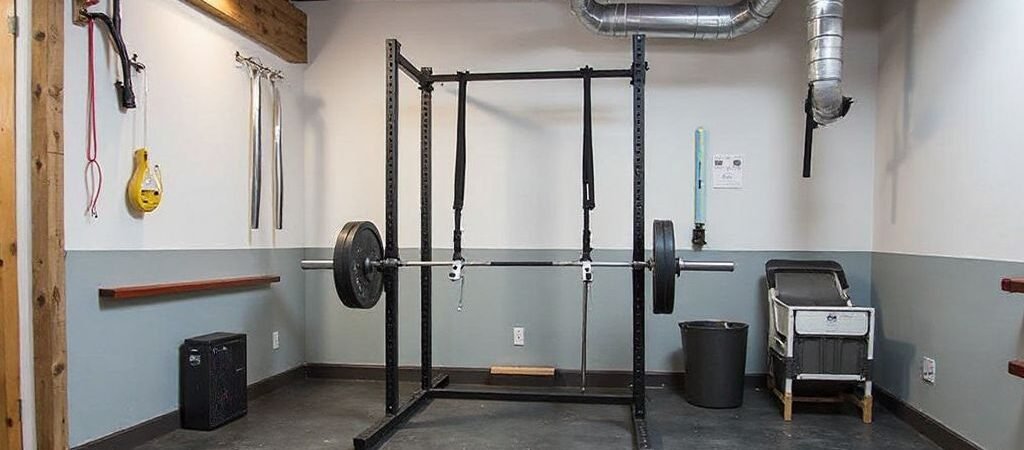
In basements, this often means measuring to the bottom of exposed joists or ductwork, not just to the drywall.
That HVAC duct running across one corner can steal several inches of clearance, making the difference between a rack fitting comfortably and not fitting at all.
The general rule that really matters here is this: your ceiling should be at least 15 inches taller than whatever rack you’re considering. That extra space accounts for several things people usually forget: the thickness of the flooring (typically 0.5 to 1 inch of rubber matting), the diameter of a loaded barbell when it’s overhead (which adds another 2 inches), and actual head clearance when you’re doing pull-ups or standing exercises.
This isn’t a theoretical safety margin; this is the actual functional space you’ll need when you’re lifting.
If you’ve got an 84-inch ceiling, that’s a standard 7-foot basement ceiling; you’re realistically looking at racks that are around 70 to 72 inches tall. If your ceiling measures 96 inches, that’s 8 feet, you’ve got more flexibility and can consider racks up to about 80 inches tall, which opens up considerably better options for taller lifters and gives you way more breathing room for overhead movements.
The thing that catches people off guard is how flooring impacts this equation. You need solid flooring to protect your foundation and reduce noise, but those half-inch or inch-thick rubber mats literally steal precious vertical space.
I’ve seen plenty of gym owners realize too late that their “perfect fit” rack became unusable once they properly installed flooring.
They measured everything to the exact inch without accounting for mats, and suddenly they’re banging their head on the ceiling during pull-ups.
Temperature and humidity also matter more than you’d think. Basements tend to be damp, which means rust becomes a real concern over time if you buy cheap powder-coated steel.
Garages swing between freezing in winter and sweltering in summer, which can affect any attachments made from different materials that expand and contract at different rates.
Ceiling height is only one factor — this detailed guide on choosing a power rack for your garage covers steel gauge, hole spacing, attachment compatibility, and budget considerations most lifters overlook.
These aren’t dealbreakers, but they’re factors worth considering when you’re evaluating different rack options and price points.
Ceiling height is only one part of the equation — our guide to the 5 power rack features most buyers overlook covers steel gauge, hole spacing, attachment ecosystems, and the stability factors that matter just as much as whether the rack physically fits in your space.
🏋️ Ceiling Clearance Reality Calculator
Stop guessing. Know exactly if your power rack will fit safely. This calculator accounts for flooring, barbell clearance, and the real-world space you need for overhead movements.
The 72-Inch Power Rack Category
The most common short rack height you'll encounter is 72 inches, which is exactly 6 feet tall. This dimension has become the industry standard for low-ceiling solutions because it works in the majority of basement and garage scenarios while still providing reasonable functionality for most lifters under 6'2" or so.
The REP Fitness PR-1050 has pretty much dominated this category since it launched, and for good reason. At 72 inches tall, 58 inches wide, and 48 inches deep, it fits into spaces where standard racks can't.
The construction uses 2x2-inch steel tubing at 14 gauge, which is strong enough for any home gym application unless you're regularly squatting over 500 pounds; even then, it'll probably hold up fine.
What makes the PR-1050 stand out is how it doesn't feel like a compromised version of a real rack. You get dual pull-up bars at two different diameters, 1.25 inches and 2 inches, which theoretically gives you grip variety, though honestly, most people end up using just one diameter consistently and ignoring the other.
The uprights have laser-engraved numbering every five holes, which is surprisingly useful when you're quickly adjusting heights between exercises and don't want to count holes like you're some kind of mathematician.
The weight capacity for racking is 700 pounds, which sounds impressive but is actually pretty standard for this category. The more important detail is the weight horn pegs on the rear base.
These serve double duty as plate storage and as ballast. When you load plates onto those rear pegs, you're adding 30 to 50 pounds of stabilizing weight to the back of the rack, which dramatically reduces wobbling without requiring you to bolt it to your concrete floor.
This is a genuinely clever design feature that makes the rack way more stable without permanent installation.
Titan Fitness offers a competitive alternative, the T-2 series, which stands 71 inches tall (also comes with 83" option) and uses slightly thicker 12-gauge steel. The Titan costs about $75 to $100 less than the REP, which appeals to budget-conscious buyers, but you're trading off some features.
The T-2 typically comes with just a single 1.25-inch pull-up bar rather than dual bars, and Titan's warranty is only 1 to 2 years, compared to REP's lifetime coverage on the frame.
That warranty difference matters more than it might seem. If something goes wrong three years from now, you're either covered or you're buying replacement parts out of pocket.
The steel gauge difference between 12-gauge and 14-gauge matters more on paper than in practice for most home users. Both will handle anything a typical lifter throws at them without bending or failing.
You'd need to be dropping loaded barbells from overhead repeatedly to actually damage either one, which, hopefully, you're not doing in your home gym anyway.
The real consideration with 72-inch racks is who they work for and who they don't.
If you're shorter than about 6'2" and you're okay with some minor exercise modifications, these racks deliver excellent value. They'll hold up for decades of regular use, they fit in tight spaces, and they cost a reasonable amount.
But if you're taller than that, you're going to struggle with pull-ups and overhead movements because there's just not enough vertical space between your head and the ceiling when you're hanging from a bar that's only 68 inches off the ground.
Your knees will drag, your head will bump the ceiling at the top of the movement, and the whole experience becomes cramped and frustrating.
Both the Titan T3 and REP PR-4000 offer low-profile height configurations worth considering — see our full side-by-side comparison for a complete breakdown of every spec that matters.
The 80-Inch Middle Ground
Something interesting has happened in the market recently: manufacturers realized there's a sweet spot around 80 inches tall that bridges the gap between ultra-compact 72-inch racks and standard 84-inch models. The Body Solid GPR-400 exemplifies this trend perfectly, and it's become increasingly popular among people who have just enough ceiling height to make it work.
At 80 inches, this rack needs about 95 inches of ceiling clearance, accounting for flooring and barbell diameter, which means it'll fit in a standard 8-foot ceiling space with careful planning around flooring thickness. What you gain for those extra 8 inches of height is really significant.
Taller lifters can actually use the pull-up bar without their knees dragging on the floor or having to bend their legs awkwardly throughout the entire movement.
Overhead pressing becomes genuinely comfortable, rather than a cramped compromise where you're worried about punching a hole in your drywall. The rack just feels more like a real power cage than a scaled-down version that requires constant mental adjustments about how high you can move the bar.
The GPR-400 maintains commercial-grade construction with heavy-gauge steel and full safety features, including adjustable spotter arms and quality J-cups that won't scratch your barbell. The footprint is still compact enough for basement gyms, but the extra height makes a massive difference in how the rack actually functions during your workouts.
For those watching their budget, the Titan T-2 Series Power Rack offers compelling value in this height category. Available in both 71-inch and 83-inch versions, the T-2 delivers solid construction through 14-gauge steel uprights with laser-cut holes for precise adjustment. The included J-hooks feature nylon plastic backing that protects your barbell's knurling during thousands of racking contacts, a detail often missing on budget racks. Pin-and-pipe safeties come standard, providing reliable protection during solo training sessions.
The 83-inch version fits the 8-foot ceiling scenario with about 13 inches to spare once you account for flooring, while the 71-inch option serves truly space-constrained basements. The integrated pull-up bar uses a skinnier 1.25-inch diameter that some lifters prefer for grip training. With an 850-pound rackable capacity and 2,200-pound total capacity, the T-2 handles serious training loads without the premium price tag. It's not the beefiest rack on the market, but for home gym owners building their first setup or working within tight budgets, it delivers essential functionality without compromise on safety features.
The trade-off is obvious: it won't fit in the absolute lowest ceiling spaces, which force you into the 72-inch category.
But if you measure your ceiling and you've got 95 to 96 inches to work with, seriously consider going with an 80-inch rack instead of automatically choosing the shortest option available. The difference in usability is substantial, especially if you're taller than average or you really value being able to do full-range pull-ups without modification.
This height category is expanding as manufacturers catch on to the demand. REP offers an 80-inch version of their PR-4000 series with 3x3-inch uprights for people who want beefier construction, and several other brands are introducing similar models.
The market is starting to recognize that 80 inches might actually be the better default choice for most people with "low" ceilings, reserving the 72-inch ultra-compact power rack options for truly constrained spaces where every inch matters.
Folding Wall-Mounted Solutions
If your ceiling is low and your floor space is really limited, maybe you're sharing a garage with vehicles, or you've got a small basement room that serves many purposes, folding wall-mounted racks deserve serious consideration, even though they're more expensive upfront. These racks solve a different problem than freestanding cages, and they do it extremely well.
The PRx Performance Profile PRO is the premium option in this category. When folded, it extends just 4 inches from the wall, which means you can literally walk past it or park a car in front of it without even noticing it's there.
When deployed for lifting, it extends about 21 inches, giving you enough depth to squat and bench safely while consuming far less space than a standard 48-inch-deep freestanding rack.
The catch is installation. You're permanently bolting this thing into your wall studs, which means you need to find solid framing and commit to that location.
You can't easily relocate it like you can with a freestanding rack that just sits on the floor.
If you decide later you want your gym in a different spot, you're looking at patching drywall holes and starting the whole installation process over again. The price is also considerably higher, expect to pay $1,500 or more depending on configuration and attachments, which is three to four times what a decent freestanding 72-inch rack costs.
Titan makes a more affordable folding alternative in their T-3 series wall mounted folding rack, with prices starting around $600 to $800 for shorter models. The construction uses 11-gauge steel, making it beefier than their freestanding racks, which makes sense given the stresses of wall mounting.
These Titan folding models come in 82-inch and 91-inch heights, so choose carefully based on your actual ceiling clearance and make sure you're not buying something that won't fit.
The advantage of folding racks goes beyond just floor space. They're excellent for apartments or condos where you can't have heavy equipment permanently occupying your living area.
When your rack folds flat against the wall, your gym space becomes a regular room again, which matters tremendously if you're working with limited square footage or if other people in your household need that space for non-gym activities.
The disadvantage is versatility. Once it's mounted, you're committed to that spot and that configuration.
If you realize later you want to add cable attachments or expand your setup in ways that need different positioning, you're kind of stuck.
And not every exercise works as smoothly on a folding rack; the depth when extended is shallower than freestanding racks, which can feel cramped for certain movements like walking lunges or anything that needs you to step backward significantly.
Squat Stands for Minimalists
An often-overlooked option is to ditch the full cage concept entirely and opt for heavy-duty squat stands instead. The Rogue SML-1 is the gold standard here: at 72.25 inches tall, with 3x3-inch uprights made from 11-gauge steel, it's built like an absolute tank but without the connecting top cross members that a full cage has.
Squat stands give you rock-solid J-cups for squatting and benching, and you can add spotter arms for safety that function essentially the same as the safety bars in a full cage. What you lose is the integrated pull-up bar and the full enclosure that a cage provides.
This matters less to many lifters than you might think.
If your primary focus is barbell work and you can do pull-ups elsewhere, a doorway bar, outdoor equipment, or a separate wall-mounted bar, then a squat stand setup actually makes a lot of sense. You're getting extremely solid construction for the movements that matter most, without paying for or dealing with the space requirements of a full cage structure.
The advantage is height flexibility. Because there's no top crossbar, ceiling height becomes less of an issue; you just need clearance for your head and the barbell, not for a structural top element.
This means you can sometimes squeeze a squat stand into spaces where even a 72-inch full rack wouldn't comfortably fit, particularly if you have weird ceiling obstacles like low-hanging pipes or ductwork that would interfere with a cage's top structure.
The Rogue SML-1 is expensive for what it is; you're paying premium prices for American manufacturing and Rogue's reputation. But the build quality is genuinely exceptional, the welds are clean, the steel is thick, and the powder coating holds up better than cheaper choices.
The resale value stays strong if you ever need to sell, which softens the initial price sting somewhat.
For lifters who want the most durability and don't care about having a full cage with an integrated pull-up bar, the squat stand approach is genuinely worth considering. You're simplifying your setup, reducing the footprint, and eliminating ceiling height concerns for the structure itself while still maintaining safety and functionality for all your main barbell movements.
Steel Gauge and What Actually Matters
There's a lot of confusion around steel gauge numbers because the system works counterintuitively; lower numbers mean thicker steel. An 11-gauge rack is made from thicker, stronger steel than a 14-gauge rack.
Steel gauge numbers can be counterintuitive because lower numbers mean thicker steel, so if you want to see the exact thickness differences, this steel gauge thickness chart breaks it down clearly.
This trips people up constantly when they're comparing specs across different models.
For practical home gym use, here's what actually matters: 14-gauge steel, as used by the REP PR-1050, is completely adequate for loads up to 700 pounds and regular home use. The steel won't bend, won't rust if you maintain it reasonably well, and will last decades with normal lifting.
Unless you're planning to open a commercial gym or you're a competitive powerlifter regularly handling 600+ pound squats, 14-gauge is perfectly fine.
12-gauge steel, like the Titan T-2 uses, is marginally thicker and adds some durability, but you're not going to notice a real-world difference unless you're really abusing the equipment with dropped bars or extremely heavy dynamic movements. The thickness difference is about 0.02 inches, which sounds tiny because it is.
Both gauges will handle anything a typical home lifter does without issue.
11-gauge steel, as used by the Rogue SML-1, is overkill for most home users but offers two genuine advantages. First, it genuinely is stronger and more rigid, which matters if you're lifting truly heavy weights or doing explosive movements like Olympic lifts where the rack takes significant impact forces.
Second, thicker steel holds paint and powder coating better, which means less chipping over time and better rust resistance in humid basements over many years of use.
The more important structural consideration is weight distribution and stability. A lighter-gauge rack can be perfectly stable if it's properly designed with a wide base and if you use weight horns to add ballast to the rear.
Conversely, a heavy-gauge rack with a narrow footprint can still wobble annoyingly if you're doing kipping pull-ups and haven't bolted it down.
The gauge number is just one factor in overall stability.
Most quality racks in the 72-inch category are designed to be stable without bolting if you load them properly with plates on the weight horns. But if you've got the ability to bolt into concrete and you're not planning to move the rack, absolutely do it.
The stability improvement is noticeable, especially during dynamic movements like pull-ups or when you're creating horizontal forces on the uprights.
Hole Spacing and Daily Usability
This seems like a minor detail until you're actually using the rack daily, at which point it becomes surprisingly important. Most quality short racks use 2-inch hole spacing on the uprights, which means your J-cups and safety arms adjust in 2-inch increments up and down the posts.
For most people, 2-inch spacing is the sweet spot. It's precise enough to dial in comfortable squat, bench, and press heights without getting stuck in awkward positions.
It's coarse enough that you're not overwhelmed with options or spending forever making micro-adjustments every time you switch exercises.
You can quickly move your J-cups up or down a hole or two and get back to lifting right away.
Some budget racks use 4-inch spacing, which is really too coarse for comfortable use. The difference between adjustment positions becomes so large that you often can't find a perfect height; you're stuck choosing between "too high" and "too low" for certain exercises, with no middle ground available.
This is particularly annoying for bench press, where bar height at the start position is crucial for proper setup and shoulder safety.
A few boutique or premium racks offer 1-inch spacing, which is extremely precise but honestly overkill for most applications. It's nice to have if you're a competitive lifter who needs exact positioning for meet tries, but for regular training, it doesn't provide enough benefit to justify paying significantly more.
You'll spend extra time adjusting and re-adjusting without achieving meaningful results.
The REP PR-1050's numbered holes, laser-engraved every five holes, are a user-experience detail that matters more than you'd expect. When you're switching between exercises, being able to quickly identify "hole 15" or "hole 20" without counting from the bottom is genuinely convenient.
It sounds trivial, but it's one of those features you don't appreciate until you've used a rack without it and found yourself counting holes every single time you adjust height, which gets old fast.
The Pull-Up Bar Reality for Power Racks for Low Ceilings
Let's talk honestly about pull-ups in short racks because this is where marketing claims and reality diverge pretty sharply. A 72-inch rack typically has a pull-up bar mounted somewhere around 68 to 70 inches off the floor, depending on the exact design and how the bar attaches to the uprights.
If you're 6 feet tall or shorter and you can do pull-ups from a dead hang, this works fine; you'll have a few inches of clearance between your head and the ceiling at the top of the movement, and your knees won't drag on the floor at the bottom. The experience isn't perfect, but it's functional enough to do your pull-up sets without major compromises.
But if you're taller than about 6'2", pull-ups in a 72-inch rack become genuinely problematic. Your head hits the ceiling at the top of the rep, or you have to keep your knees bent the entire time, or you can only do partial-range pull-ups that don't actually take you all the way to chin-over-bar height.
The experience becomes so frustrating that many tall lifters just give up on doing pull-ups in their short rack altogether.
The dual pull-up bar feature that racks like the REP PR-1050 advertise sounds great in theory: you get a 1.25-inch-diameter bar and a 2-inch-diameter bar for grip variety. In practice, most people pick one diameter they prefer based on hand size and comfort, and then never use the other. It's not a bad feature to have, and having the option is nice, but it's not as transformative as the marketing copy suggests.
You're probably going to use one bar 95% of the time.
If you're a tall lifter stuck with a low ceiling, you've got a few practical workarounds. You can install a separate pull-up bar somewhere else, maybe in a doorway using one of those removable bars, or mounted to ceiling joists if they're accessible in an area with slightly higher clearance, or even outdoors if you've got a suitable location like a deck or covered patio.
Pull-Up Reality Checker
Let's be honest about your space. Enter your measurements to see if full pull-ups are actually possible in your setup.
You can switch to resistance-band pull-downs or lat-pulldown attachments that don't require overhead space.
Or you can accept that your home gym just won't include pull-ups, and you'll handle that movement pattern at a regular gym or outdoor park equipment.
The 80-inch racks, like the Body Solid GPR-400, solve this problem much better for taller users, which is a major reason to seriously consider that height category if your ceiling allows it. That extra 8 inches makes a massive difference in pull-up comfort and range of motion for anyone over 6 feet tall.
Exercise Modifications for Tight Spaces
Even with a well-chosen short rack, you'll need to adapt some exercises to work within your space constraints. Overhead pressing is the biggest challenge.
Standing overhead press with a barbell becomes impossible in many low-ceiling gyms because the bar path at full extension reaches too high, and you're literally pressing the barbell into your ceiling joists.
The solution is switching to seated overhead press variations. A seated press on a bench reduces your overall height by about 18 inches, which is usually enough to make the movement work even in tight spaces.
You lose a bit of core engagement compared to the standing press, but you still get the same shoulder development and strength gains.
You can also use dumbbells instead of a barbell for overhead work, which gives you more control over the movement path and keeps everything slightly lower.
Landmine attachments become particularly valuable in low-ceiling gyms because they angle pressing movements at roughly 45 degrees instead of straight vertical, keeping everything well below ceiling height. Landmine presses and overhead work feel different than traditional strict press, but they provide similar muscle activation and pressing strength development without the clearance concerns.
A landmine attachment costs about $30 to $50 and opens up a whole range of exercises that work perfectly in confined spaces.
For exercises like squats and deadlifts, low ceilings aren't really an issue at all; you're not moving the bar higher than chest or shoulder level anyway. Bench pressing works fine as long as you account for the slight upward arc of the bar path at lockout, which adds about 3 or 4 inches above your chest at the top.
In most 7 to 8-foot ceiling spaces, bench press clearance is adequate as long as you've measured properly and accounted for your flooring thickness.
The psychological aspect of training in a low-ceiling space is real and varies dramatically between people. Some lifters feel cramped or claustrophobic in a basement gym with limited vertical space, which affects their mental approach to workouts and performance.
Others don't mind it at all and actually appreciate the focused, den-like atmosphere where everything feels close and contained. There's no predicting which camp you'll fall into until you're actually training in the space regularly for a few weeks.
Once you’ve confirmed a rack will physically fit your ceiling height, the next critical step is making sure it can safely handle the weight you plan to lift—this power rack weight capacity and safety guide breaks down what those numbers actually mean in real-world use.
People Also Asked
What is the shortest power rack available?
The shortest full-power racks available are 71 to 72 inches tall, which is exactly 6 feet. The Titan T-2 series and REP Fitness PR-1050 are the most popular options in this height range.
These racks work in basements with standard 7-foot ceilings when you account for flooring thickness and the 12 to 15 inches of clearance needed above the rack for safe use.
Anything shorter than 71 inches starts to fall into squat-stand territory rather than full-cage designs.
Can you do pull-ups in a low-ceiling basement?
You can do pull-ups in a low-ceiling basement if you're under 6'2" tall and your ceiling is at least 84 inches high with a 72-inch rack installed. Taller lifters will struggle because there isn't enough clearance between the pull-up bar and the ceiling for a full range of motion. Many people solve this by installing a separate doorway pull-up bar in a different area of the house, using outdoor equipment, or switching to lat pulldown attachments that don't need overhead clearance.
How much ceiling height do you need for a power rack?
You need at least 15 inches more ceiling height than the rack's actual height. For a 72-inch rack, you need at least 87 inches of ceiling, but 90+ inches is better.
This accounts for the thickness of the rubber flooring, the barbell diameter when overhead, and the actual head clearance during exercises.
Standard 7-foot basement ceilings at 84 inches work with 72-inch racks when using thin flooring, but 8-foot ceilings at 96 inches offer much better options.
Should I bolt my power rack to the floor?
You should bolt your power rack to the floor if you plan to do dynamic movements like kipping pull-ups or if you're lifting very heavy weights that create significant horizontal forces on the uprights. Most modern short racks include weight horns on the rear base where you can load 50 to 100 pounds of plates for stability, often eliminating the need to bolt during normal lifting.
Bolting provides the most stability but needs drilling into concrete and makes the rack permanent.
What is the difference between 11-gauge and 14-gauge steel racks?
The gauge number refers to the thickness of the steel; lower numbers indicate thicker steel. An 11-gauge rack has steel about 0.12 inches thick, while a 14-gauge rack has steel about 0.075 inches thick.
For home gym use, 14-gauge handles any weight a typical lifter uses without bending or failing.
The 11-gauge steel is stronger and holds powder coating better over time, which matters more for commercial gyms or very humid environments where rust is a concern.
Can tall people use a 72-inch power rack?
Tall people over 6'2" will struggle with 72-inch power racks because there isn't adequate space for pull-ups or overhead movements. The pull-up bar sits around 68 to 70 inches off the ground, leaving insufficient clearance between your head and the ceiling at the top of the movement.
Tall lifters should look for 80-inch racks if their ceiling allows, or choose squat stands without integrated pull-up bars and handle pull-ups elsewhere.
What are the best budget power racks for low ceilings?
The Titan T-2 series offers the best budget option for low ceilings at around $300-$350, depending on sales and attachments. It features 12-gauge steel construction, stands 71 inches tall, and includes basic J-cups and safety bars.
The REP PR-1050 costs about $75 more but includes a lifetime warranty, dual pull-up bars, and better overall build quality, making it worth the upgrade if your budget allows.
Do folding wall racks work for low ceilings?
Folding wall racks work extremely well for low ceilings and limited floor space because they extend only 4 inches from the wall when folded. The PRx Profile and Titan T-3 folding racks are available in various heights, including models under 82 inches that fit 8-foot ceilings. The main disadvantages are higher cost, permanent wall installation that needs finding studs, and shallower depth when deployed, which can feel cramped compared to freestanding racks.
Key Takeaways for Power Racks for Low Ceilings
Measure your actual ceiling height to the lowest point, then subtract 15 inches to find your most usable rack height. Account for flooring thickness, barbell diameter, and head clearance; most people who order racks that don't fit made mistakes in this calculation.
The REP Fitness PR-1050 at 72 inches tall delivers the best overall value for standard low-ceiling basements at around $400, with a lifetime warranty, dual pull-up bars, and 14-gauge steel construction that handles everyday home lifting.
Steel gauge matters less than stability features for home use. Both 14-gauge and 12-gauge steel handle typical lifting loads without issues, but weight horns for adding plate ballast make a bigger practical difference in day-to-day stability than steel thickness.
Lifters over 6'2" tall should avoid 72-inch racks if possible because pull-ups and overhead movements become cramped and uncomfortable. Look for 80-inch racks if your ceiling measures 95+ inches, or use squat stands without integrated pull-up bars.
Folding wall-mounted racks like PRx Profile solve extreme space constraints by folding to 4 inches from the wall, but they cost $1,500+ and need permanent installation into wall studs that you can't easily relocate later.
Two-inch hole spacing provides the right balance of adjustment precision and convenience. Avoid racks with 4-inch spacing, as they limit your ability to find comfortable heights for different exercises.
Budget racks under $300 typically use thinner steel, wider hole spacing, and shorter warranties, which makes them poor long-term value. The $350 to $500 mid-range category offers significantly better durability and features that last for decades.
The emerging 80-inch rack category provides better functionality than 72-inch ultra-compact racks for anyone whose ceiling allows the extra height. The improvement in pull-up comfort and overhead pressing clearance is substantial.
Weight horns on the rack's rear base serve double duty as plate storage and stability ballast. Loading 50 to 100 pounds of plates onto the rear pegs dramatically reduces wobbling without requiring permanent floor bolting.
The thickness of rubber flooring reduces your usable ceiling height by that amount. Half-inch mats steal half an inch of vertical clearance, which matters when you're working with tight measurements between rack height and ceiling clearance.